
Practical Essentials of GC and GC-MS

- Duration: 3 days for live courses 19.50 hours for on-demand
- Experience level: Intermediate
- Delivery methods: Face-to-face | Offsite training & consultancy | On-Demand | Online | Onsite training & consultancy | Tailored training |
- Type of course: Universal
- Applicable to manufacturer(s): Agilent | Bruker | CDS Analytical | CTC analytics | Frontier | GERSTEL | GL Sciences | Leco | OI Analytical | PerkinElmer | Scion | Shimadzu | SRI | Thermo | Varian | Waters |
- CPD Approved: Approved
- Scheduled course price: £1,200.00 + TAX per delegate
- Course discounts: RSC CAMS HEaTED Cambridge Network members receive a discount on this course
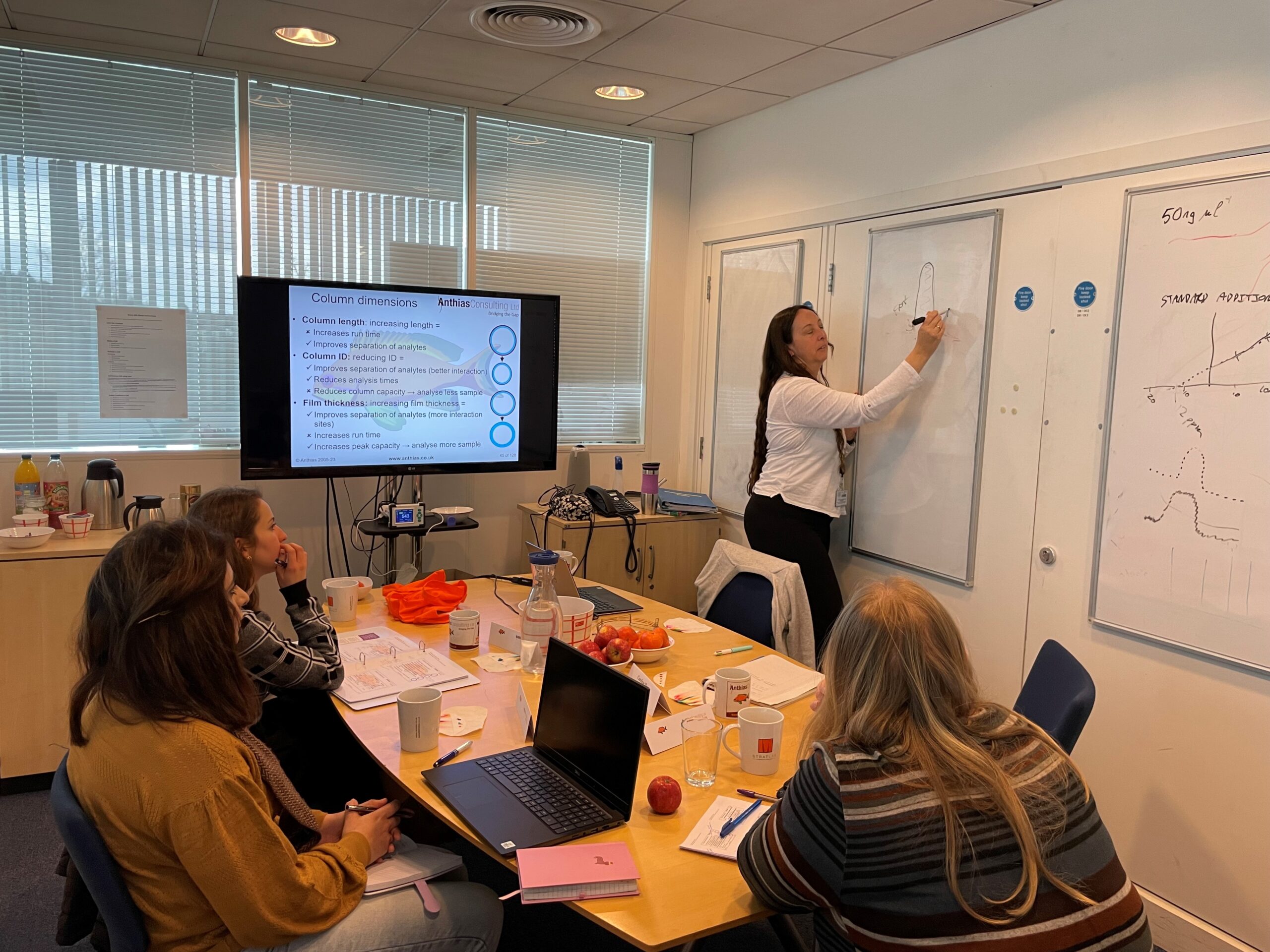
Your essential guide to gas chromatography (GC) and gas chromatography mass- spectrometry (GC-MS)
Day 1 to 3 of the Complete GC and GC-MS.
The Practical Essentials of GC & GC-MS training is approved by the Royal Society of Chemistry (RSC) for the purposes of Continuing Professional Development (CPD). This essential 3-day classroom-based training designed for students, professionals and chemists provides an essential understanding of GC and GC-MS covering the theory, instrumentation, operation, optimisation, and applications of modern GC and GC-MS systems. This course takes participants through every stage of the analytical workflow, from understanding the principles of separation and instrument design, through to sample introduction, column selection, detector technologies, mass spectrometry, and data analysis.
If you are looking to strengthen your theoretical understanding of GC and GC-MS, this course provides the knowledge and practical insight required to achieve reliable, high-quality analytical results. This course is packed full of examples and practical tips, as well as making full use of parts of the GC and GC-MS to handle (or see if virtual) including analytical columns, septa, a quadrupole and turbo pump.
Why should I join?
By completing this GC and GC-MS training, you will develop a thorough understanding of how GC and GC-MS systems work and how each component contributes to analysis, giving you:
- Understanding of GC and GC-MS instrumentation and analytical workflows
- Information of carrier gases, gas delivery systems, and pneumatic controls in GC and GC-MS
- Understanding of sample introduction and injection techniques
- Insight into chromatographic theory, separations, and column selection
- A detailed overview of GC detector and their applications
- Understanding of GC and GC-MS instrumentation, ionisation techniques, and mass analysers
- Overview of chromatographic and mass spectral data interpretation
- A great refresher for those who haven’t worked with GC and GC-MS for a while
What would I learn?
This course focuses on the practical theory of GC and GC-MS systems, providing a structured understanding of the analytical process, you will learn:
- The principles of GC and GC-MS
- The function of each component within a GC and GC-MS system
- How carrier gases, pressure control, and gas purity influence performance
- Principles of sample introduction, including split, splitless, on-column and large-volume injection (LVI) techniques
- How chromatographic separations occur and the role of stationary phases, column dimensions, and temperature programming
- How to select and optimise GC columns for different applications
- The principles of GC-MS, including ionisation, fragmentation, mass analysis, and spectral interpretation
- How chromatographic and mass spectral data are used for qualitative and quantitative analysis
- Approaches to improving sensitivity, selectivity, reproducibility, and robustness
What knowledge will I gain?
By the end of the course, you will:
- Understand the complete workflow of GC and GC-MS analysis, from sample introduction through to data interpretation
- Be able to identify and explain the function of all major GC and GC-MS components
- Understand how gas systems, inlets, columns, detectors, and mass spectrometers affect analytical performance
- Know how to select suitable columns, detectors, and operating parameters for different analyte types
- Understand chromatographic theory and how it relates to method optimisation
- How detector and mass spectrometer selection influences sensitivity, selectivity, and identification confidence
- Understand how chromatographic and mass spectral data are generated and interpreted
Is this course for me?
This GC and GC-MS training is designed for anyone who would like an essential understanding of both techniques.
- Laboratory analysts & technicians using GC and GC-MS
- Laboratory or line managers overseeing GC and GC-MS instruments and analysis
- Data analysts and report writers who work with GC and GC-MS
- Service engineers who want a chemistry focused viewpoint of GC and GC-MS
- Sales, commercial or marketing teams who work with GC and GC-MS components, instruments, or services in anyway and would like more in-depth knowledge
If GC and GC-MS touches your work in any way, this well-planned course delivered by experts in the field equips you to understand the science behind these techniques.
Course combinations
Attend the complementary GC & GC-MS Clinic course to the end of this course to obtain a full picture and learn Complete GC & GC-MS.
This course includes
- Practical Essentials of GC introduction, gases and plumbing and sample introduction
- Practical Essentials introduction to Gas Chromatography and GC-MS
- Practical Essentials of GC gases and plumbing
- Practical Essentials of GC sample introduction
- Practical Essentials of GC columns, detector and mass spectrometers
- Practical Essentials of GC columns
- Practical Essentials of GC detectors
- Practical Essentials of mass spectrometers for GC
- Practical Essentials of GC and GC-MS data analysis and sample preparation
Feedback from previous attendees
“I enjoyed the theory behind GC & GC-MS. The different types of detectors and all the topics that relate to my work.” Laboratory Analyst Apprentice, 2024
“The course was dense with knowledge and covered all aspects of GC. On previous courses the trainer didn’t answer questions outside of the slides. Not so in this course” Lab Supervisor, 2024
“I enjoyed a broad (but detailed!) overview of ‘everything’ I needed to know about GCs. The course instructor used detailed explanations, analogies and course questions throughout to build confidence on every aspect covered..” Delegate (December 2023).
“(I enjoyed) the in-depth information on each and every element of the GC and what makes them happy/sad. It was amazing to learn these in depth so I can apply the knowledge to my own lab.” Rachel Holmes, Laboratory Technician, Teagasc (September 2022).
“It is comprehensive and covers all topics. The course instructor speaks very clearly and good use of analogy to explain the concept.” July 2020.
“All the course questions are a good reminder to apply each time when I need to choose a method or technique for an application.” (Module 1: Practical Essentials of Gas Chromatography and GC-MS Introduction, July 2020).
“Comprehensive knowledge about sample introduction, particularly all the diagrams with a clear explanation from the instructor.” (Module 3: Practical Essentials of Sample Introduction in GC & GC-MS, July 2020).
“I found good details illustrated in the course materials and a clear explanation of each method and technique as well as the comparison of the methods and techniques are equally interesting and useful.” (Module 3: Practical Essentials of Sample Introduction in GC & GC-MS, July 2020).
“Comprehensive knowledge about columns.” (Module 4: Practical Essentials of GC Columns, July 2020).
“I enjoyed that this module material covers all methods and detailed the why, how and the importance of each, as well as listed the pros and cons of each method.” (Module 7: Practical Essentials of Data Analysis for GC & GC-MS, July 2020).
“It is great all about different sampling and sampling preparation techniques in a structured way. I particularly enjoy the part of solid-phase sampling techniques. Diane gave an overview of all the solid phase sampling techniques, also the theory behind and how to apply. Her rich knowledge and experience add to another layer of understanding of these techniques, especially in the Q&A session.” (Module 8: Practical Essentials of Sampling & Sample Preparation Techniques for GC & GC-MS, July 2020).
“(I enjoyed) practical aspects – cutting column – taking components apart.” (April 2019).
“The method of teaching was excellent and focussed. Covered all topics related to GC and GC-MS. The slides were appropriate and good for better understanding.” Dr Azra Ahmed from the Saudi Ministry of Health (April 2013).
“Excellent course and good knowledge of the presenter. Explanation good and broad spectrum of knowledge.” Karen Scott, a laboratory manager from CTDS Ltd (April 2013).
“Really good course and a great overview. Enjoyed relating the theory to my practical applications (and problems) in the lab.” Ellie Sargent from The Open University (February 2013).
“A lot of new information that is helpful to me in my study.” Layla Al Omran from Birmingham University (February 2013).
“Good background knowledge on GC techniques and instrumentation, these were the things I was lacking.” Research Technician, Metabolomic Research, Manchester University.
“Very good overview of the technique and possibilities, but also great practical tips. It’s a lot of information – sometimes a little too much maybe, but it makes it possible for everyone to pick out the points that are important for them. Having a reasonably small group like we had, gives more chance for personal guidance – get your answers!” Femke Sterckx, PhD Student, Centre for Malting and Brewing Science, University of Leuven, Belgium.
“Diane presented the material well with easy digestable content.” Adnan Zulfqar, PhD Student, The Open University.
“Strong background and practical focus. A session of hands-on would be advantageous. Instructors and organisers are warm and nice, yet professionable and knowledgeable. A very good exposure to GC-MS, current knowledge, industry, networking and technologies.” Su Shiung Lam, PhD Student, Department of Engineering, University of Cambridge, UK.
“Brilliantly presented, warm and cosy atmosphere. Very informative, use of full documentation. Nice tips to organise yourself.” Service Engineer, Separation Sciences.
“I found the course refreshed my knowledge and also taught me some things I didn’t know beforehand. Some really good tips! Explained some techniques I had heard of but had no experience or knowledge of”. Moya McCarron, Laboratory Technician, University of Liverpool.
“Rather a lot of information over a short period, I will need to sit in front of my instruments with the manual and go through it asap”. Dr. Stan Lambert, John Moores University, Liverpool.


