
Published: 15th August 2016 | © Anthias Consulting Ltd
Method miniaturisation is the squeezing of as many instrumental and analytical parameters as possible to optimise efficiency. Variables that can be examined include extraction solvent, extraction technique, injection onto the column, separation on column, quantitation via the detector and finally the cycle time of one analytical run. As we strive to make the method more robust, we should improve quality, obtain an equivalent if not better Limit of Detection (LOD) and deliver the result more quickly and hence more cheaply.
Extraction technique
Extraction techniques for solids have typically evolved through speed and capacity [1], as efficiency has historically been universally satisfactory. Any piece of equipment that can run more samples in parallel, per unit space, should be investigated in this process. For example, Soxhlet extraction was widely used in the 1990’s and still is in some labs (!), yet it only extracts one sample at a time, this is hardly high throughput and there are other, quicker methods that give the same recoveries, such as soxtherm, sonication or orbital shaking.
Soxtherm introduced a level of parallel extraction into the equation but this pales into insignificance when compared to high energy sonication. Whilst the latter has capacity for say 60 soil samples per hour (in EPA vials), solvent wettability for a sticky clay may be a challenge. In comparison, an orbital shake at 300 rpm for 20 minutes should reduce lumps of clay in a solvent to finely divided solutions and allow anything up to 600 samples per hour given its larger surface area and stacking capabilities. Other, more expensive kit, such as Accelerated Solvent Extraction (ASE) uses temperature and pressure to force solvent through a solid matrix, for normal soils this may be overkill but for sediments it may be the only solution, it doesn’t have a great capacity (50 samples in 15 hours) so is similar to microwave extraction in that respect. The latter technique can handle solvents and acids although hotspots can be an issue. In short, a little research, some experiments and a robust method validation should provide the route to a bullet-proof cost-effective methodology.
Table 1: Relative cost benefit analysis / relative cost per sample table
| 6 PAH/hr soxtherm | 60 PAH/hr sonicate | |
| Analyst | 1.1 | 0.1 |
| Standards solvents etc. | 0.5 | 0.1 |
| Vessels | 1 | 0.14 |
| Extraction relative cost per sample | 2.6 | 0.34 |
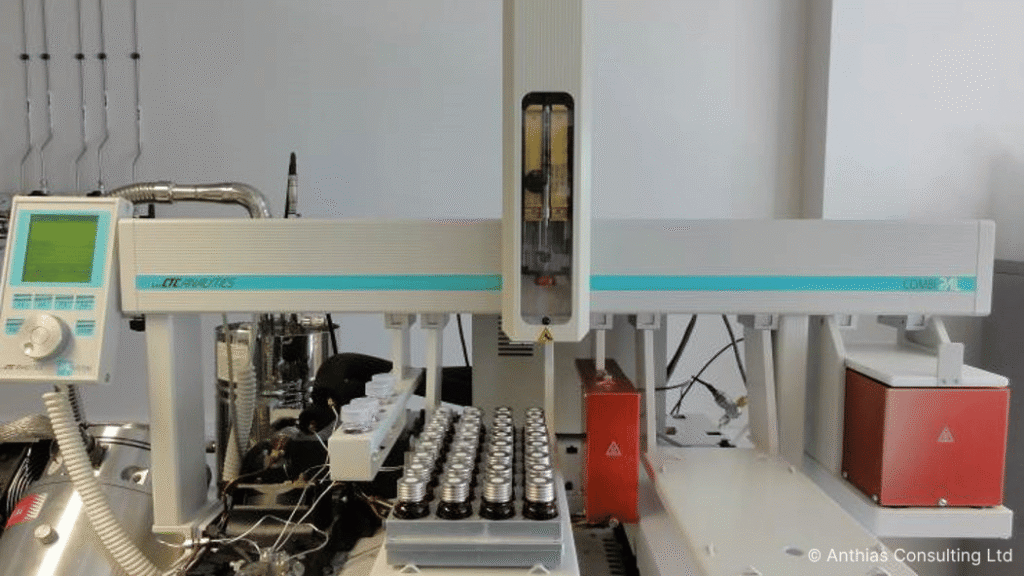
For other sample types, the question for high throughput analysis should always be, can I automate the sample preparation directly onto the GC? Techniques like thermal desorption (TD); solid phase micro-extraction (SPME) and similar; headspace (SHS and DHS); purge-and-trap (P&T); and pyrolysis (Py) are already hyphenated to the GC, however, XYZ autosamplers (Figure 1) enable the direct injection after automated sample preparation using liquid-liquid extraction (LLE) and solid phase extraction (SPE) and even additional steps like derivatisation can be achieved – well it is a robot, so you can train it to do anything with the correct tools!
However, this is usually on the miniature scale using vials up to a maximum of 20 mL but, this results in the use of much smaller volumes of consumables, like solvents and from the sustainability aspect this can be backtracked to collecting less sample using smaller vessels, less material and weight for transportation, smaller storage capacity is needed which is especially important if stored in a refrigerator or freezer, less materials like smaller pipette tips are needed in preparing the sample, therefore the overall sustainability of the analysis is improved.
The majority of the extract can then be injected using large volume injection (LVI) effectively putting the same amount of analyte onto the column. Investment in XYZ GC autosamplers can, over time, be beneficial, not all tools need to be purchased at the same time and as required the autosampler can be upgraded to carry out other sample injection techniques.
References:
[1] USEPA SW-846 Revisions 1 to 5 – Test Methods for Evaluating Solid Waste, Physical/Chemical Methods, contains USEPA 8270 method – semi volatile organic pollutants in solid waste, soil, water, and air matrices using GCMS. First published in Chromatography Today Feb/Mar 2016 issue .
To find out more about sample preparation techniques visit
- Hands-on Sample preparation
- Complete Sample preparation
- Practical Essentials of GC and GC-MS data analysis and sample preparation
- Practical Essentials of LC and LC-MS mass spectrometers and sample preparation
- Practical Essentials of Elemental Analysis introduction, sample preparation, sample introduction, spectrometers for ICP-OES and AAS
Don’t forget that you can also subscribe to our newsletters and receive useful tips straight to your inbox!


