
Published: 10th October 2016 | © Anthias Consulting Ltd
Method miniaturisation is the squeezing of as many instrumental and analytical parameters as possible to optimise efficiency. Variables that can be examined include extraction solvent, extraction technique, injection onto the column, separation on column, quantitation via the detector and finally the cycle time of one analytical run. As we strive to make the method more robust, we should improve quality, obtain an equivalent if not better Limit of Detection (LOD) and deliver the result more quickly and hence more cheaply.
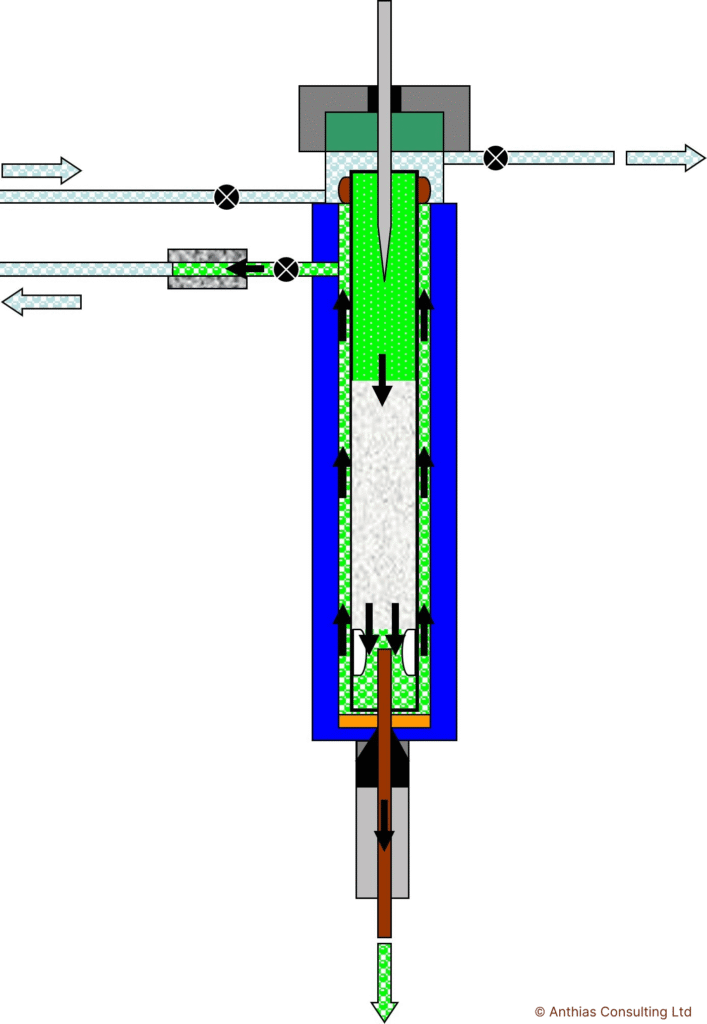
GC sample introduction – large volume injection (LVI)
For sample matrices where large extraction volumes have traditionally been necessary, i.e. waters, something fundamentally more intelligent has evolved as an injection technique, as laboratory space quickly becomes prohibitive in such instances. To miniaturise environmental water analysis to the same scale as soil analysis, the technique of large volume injection [1] (LVI) is often used. This enables the user to introduce more analyte into the column by controlling the injection of greater than a hundred times more sample dissolved in solvent but then venting almost all of the latter leaving the concentrated sample analytes to be transferred into the column for separation and detection (Figure 1). Benefits can be a smaller initial sample volume, smaller extraction solvent volume and then additionally no need for solvent evaporation, the latter can lead to volatile analyte loss.
For example, traditionally, polycyclic aromatic hydrocarbon (PAH) analysis in water was performed by liquid/liquid extraction of 500 mL water sample, with 100 mL of dichloromethane (DCM), evaporated to 1 mL and 1 µl injected; with LVI, 50 mL of water is extracted with 2 mL pentane and 100 µl of solvent injected in solvent vent mode with no subsequent requirement for evaporation, saving money on sample bottles / solvent and time from extraction to vialling. This can be taken further still using an XYZ GC autosampler using a maximum of 20 mL vials and either performing LVI or using the autosampler evaporation tool to concentrate the sample or a combination of both.
LVI is performed using a programmable temperature vaporiser (PTV) or multi-mode inlet (MMI) which is cooled to an initial low temperature to evaporate the majority of the solvent while concentrating the analytes within a packed inlet liner. The initial temperature depends on the solvent to be evaporated and the inlet is cooled using air, liquid C02, liquid nitrogen or a peltier cooler.
The payback in method miniaturisation is rapid even for small environmental labs, a period of seven months would not be untypical to see the payback for a modern LVI capability.
| 35 PAH waters / day LLE | 35 PAH waters / hr LVI | |
| Analyst | 1.5 | 0.18 |
| Standards, solvents, etc. | 0.25 | 0.01 |
| Vessels | 0 | 0.14 |
| Extraction relative cost per sample | 1.75 | 0.33 |
Table 1: Relative cost benefit analysis / relative cost per sample table
References:
[1] Large Volume Injection with Solvent Venting – Application to Trace Detection of Analytes in Water – A. Hoffmann, K. MacNamara, Gerstel GmbH & Co. KG, Eberhard-Gerstel-Platz 1, D-45473 Mülheim an der Ruhr, Germany.
First published in Chromatography Today Feb/Mar 2016 issue
To find out more about GC sample introduction techniques attend:
- Practical Essentials of GC introduction, gases and plumbing and sample introduction
- Hands-on GC theory and methods
- Comprehensive GC hardware (Agilent GC)
- Comprehensive GC hardware (Shimadzu GC)
- Comprehensive GC hardware (Thermo GC)
- Comprehensive GC hardware (Scion/Bruker/Varian GC)
To learn Large volume injection (LVI) attend:
Don’t forget that you can also subscribe to our newsletters and receive useful tips straight to your inbox!


