
Published: 31st October 2016 | © Anthias Consulting Ltd
Method miniaturisation is the squeezing of as many instrumental and analytical parameters as possible to optimise efficiency. Variables that can be examined include extraction solvent, extraction technique, injection onto the column, separation on column, quantitation via the detector and finally the cycle time of one analytical run. As we strive to make the method more robust, we should improve quality, obtain an equivalent if not better Limit of Detection (LOD) and deliver the result more quickly and hence more cheaply.
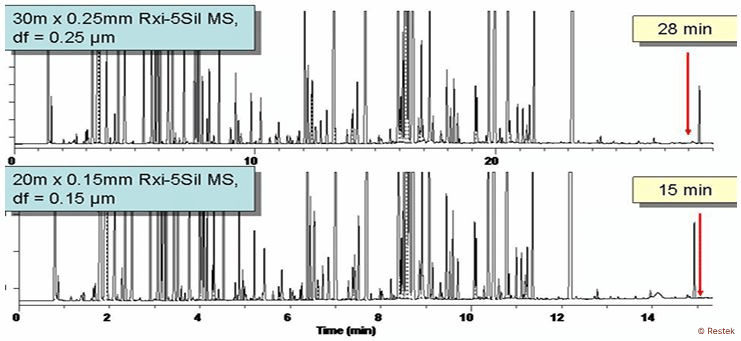
Separation on the column – changing the column dimensions, oven ramp rates or carrier gas
Two of the main aims of capillary gas chromatography is to get a good separation (resolution) and good sensitivity (signal-to-noise ratio). By using a shorter, narrower column, with a thinner film and increasing gas flows and oven temperature ramp rates, it is possible to shorten run times considerably with little or no loss in resolution or signal-to-noise ratio (Figure 1). Shortening run times reduces longitudinal diffusion and by reducing the column internal diameter and the stationary phase thickness reduces the mass transfer term of the Golay theory for open tubular columns. Method translation software has been developed by several manufacturers and is freely available to assist analysts in speeding up their analysis.
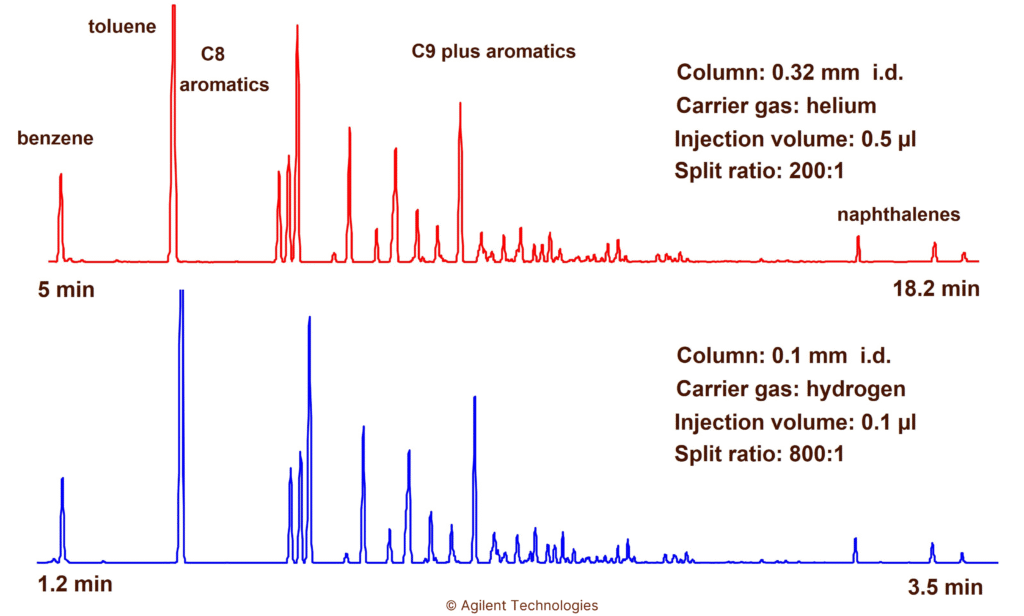
Further possible improvements include using a more efficient carrier gases like hydrogen, which compared to helium has a higher optimum average linear velocity and greater efficiency (ability to keep the molecules close together for an analyte, resulting in sharper peaks). Whilst hydrogen is known to be reactive to certain compounds, using a PTV inlet with cool injection reduces the likelihood of artefact production, leaving the major gains of improved efficiency, better signal to noise ratios and further reduced run times.
Putting both column improvements and changing the carrier gas together, can result in much shorter analysis times with little or no change in resolution and sensitivity (Figure 2).
First published in Chromatography Today Feb/Mar 2016 issue.
To learn more about GC carrier gases, columns and GC sample introduction attend:
- Practical Essentials of GC introduction, gases and plumbing and sample introduction – GC carrier gases and sample introduction
- Practical Essentials of GC columns, detector and mass spectrometers – columns
- Hands-on GC theory and methods
- Comprehensive GC hardware (Agilent GC)
- Comprehensive GC hardware (Shimadzu GC)
- Comprehensive GC hardware (Thermo GC)
- Comprehensive GC hardware (Scion/Bruker/Varian GC)
Don’t forget that you can also subscribe to our newsletters and receive useful tips straight to your inbox!


