
 Method miniaturisation is the squeezing of as many instrumental and analytical parameters as possible to optimise efficiency. Variables that can be examined include extraction solvent, extraction technique, injection onto the column, separation on column, quantitation via the detector and finally the cycle time of one analytical run. As we strive to make the method more robust, we should improve quality, obtain an equivalent if not better Limit of Detection (LOD) and deliver the result more quickly and hence more cheaply.
Extraction solvent
It is not set in stone that a solvent used for a method written c1970 should be used forever. If you could inject more solvent with no adverse chromatographic side effects, would you? Yes, of course, it’s good for business to have the best detection limits in the industry.
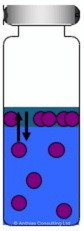
If you’re more concerned with saving money you may just enjoy the benefit of changing solvent and extracting less initial sample, it can then be automated by an XYZ autosampler in a vial (Figure 1). Depending on the new solvent choice, another benefit could be that you can start the analytical run at a higher initial oven temperature meaning shorter cycle times.
Old soil semi-volatile methods that traditionally used dichloromethane, boiling point (BP) 39.6˚C, are easily replaced with a mixture of hexane/acetone (90:10 v:v), the BP of which is nearer 68˚C. 1 µl of the former has an expansion volume of ~400 µl in a hot splitless inlet, the latter is ~200 µl which in a liner of volume ~1000 µl can make a big difference. The hexane/acetone also has some polarity if required, extraction efficiency will be sufficient (and can be performance-checked by a Proficiency Testing scheme if need be) and if anything, it brings out less matrix, yet the starting oven temperature for solvent focussing can be increased from 30˚C to 50˚C, significantly shortening cycle times. Added benefits of the proposed mixture are that it is eliminating a chlorinated solvent simultaneously improving health and safety and the environment.
Table 1: Polarity indices
| Solvent | Polarity index |
| Dichloromethane | ~3.1 |
| Hexane | ~0.1 |
| Hexane/Acetone (90:10) | ~0.56 |
First published in Chromatography Today Feb/Mar 2016 issue
To find out more about sample preparation techniques visit
- Hands-on Sample preparation
- Complete Sample preparation
- Practical Essentials of GC and GC-MS data analysis and sample preparation, day three of our Complete GC and GC-MS
- Practical Essentials of LC and LC-MS mass spectrometers and sample preparation, day three of our Complete LC and LC-MS
To find out more about GC sample introduction techniques attend
- Practical Essentials of GC introduction, gases and plumbing and sample introduction day one and Practical Essentials of GC sample introduction, module three of our Complete GC and GC-MS
- Hands-on GC theory and methods , day one of our Hands-on GC and GC-MS
- Comprehensive GC hardware (Agilent GC)
- Comprehensive GC hardware (Shimadzu GC)
- Comprehensive GC hardware (Thermo GC)
- Comprehensive GC hardware (Scion/Bruker/Varian GC)


