
Published: 24th May 2011 | © Anthias Consulting Ltd
Most problems that occur in gas chromatography either gradually increase in severity over time or suddenly become a large issue, preventing further analysis by the instrument.
Random problems occurring infrequently are often ignored for long periods of time as the sample is simply re-analysed and the results are correct the second time. The problem itself can be hard to track down to determine the cause and then to provide a fix, as it isn’t a continuous problem.
HOW TO FIX THIS
As with all problems, the best place to start is to divide the whole instrument (from gas source and sample preparation to data analysis and reporting) into modules and consider the likelihood of the particular issue arising at each point.
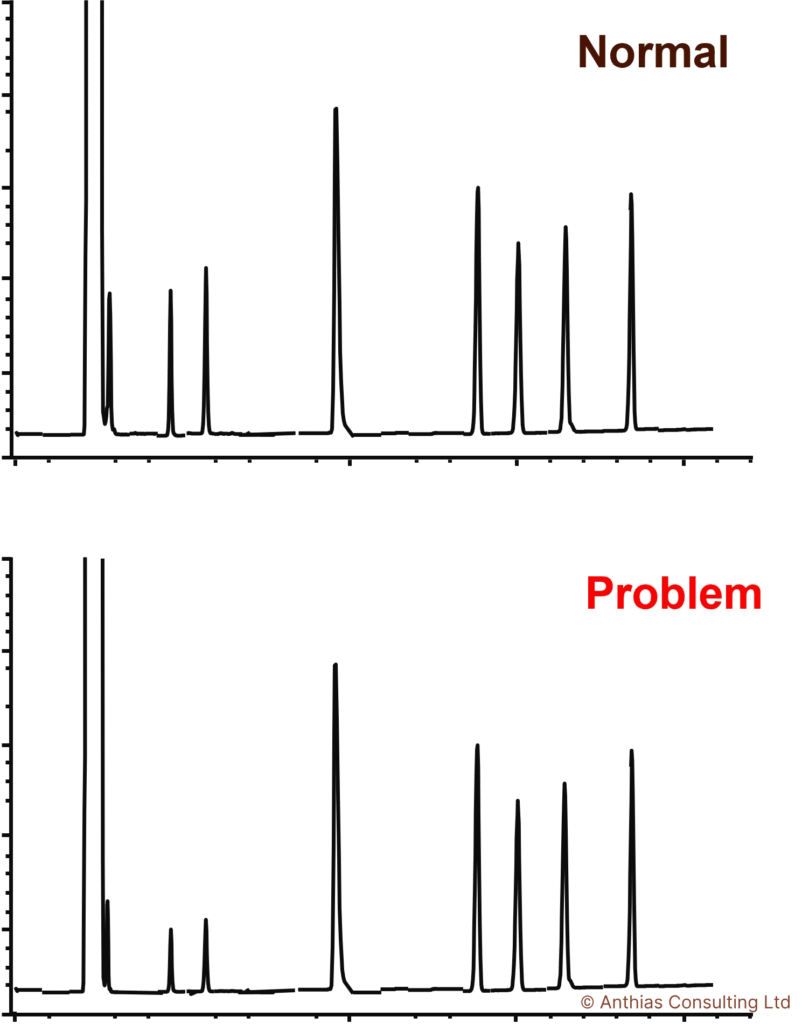
For example, the random loss in sensitivity of some samples could be caused by a number of different modules:
1) Sample problem: sample preparation hasn’t worked for that particular sample, could be a matrix effect.
2) Vial problem: not enough sample placed into the vial so the needle doesn’t reach or vial not sealed resulting in evaporation (Figure 1).
3) Syringe problem: (partial) temporary blockage in the needle from sample vial septum or inlet septum (cone tip needle is best to avoid this); particles in the sample temporarily blocking the needle (take sample from higher up the vial rather than from the bottom); plunger sticking from previous sample (lots of sample washes needed with two different polarity solvents, last one in methanol to prevent drying out and sticking or could use a PTFE tipped plunger); plunger worn and not pulling up full amount of some, more viscous samples (replace plunger or syringe; use a viscosity delay).
4) Inlet leak: a random leak on the instrument, usually the inlet, it could be that some samples have a higher vapour pressure and so this problem is random (leak test).
5) Detector problem: detector having sensitivity issues (inspect the problem chromatogram’s baseline, has this changed compared to a normal chromatogram or is it just the peaks themselves?).
Use of an internal standard can help determine where the problem is occurring: sample, sample preparation or sample analysis, as well as normalisation to help reduce the problem’s effects. Depending on your instrument and samples, some of the areas above may be more obvious as the cause than others, then it is a case of checking the easiest ones first and moving through from there.
To gain more knowledge about the individual parts of the instrument, stages of analysis and to learn how to maintain and troubleshoot the instrument, attend our Complete GC & GC-MS course.
Troubleshooting is covered in:
- Applied GC and GC-MS maintenance and troubleshooting, day five of our Complete GC and GC-MS
- Applied GC and GC-MS troubleshooting, module 12 of our Complete GC and GC-MS
- Hands-on GC and GC-MS troubleshooting, day five of our Hands-on GC and GC-MS
- Comprehensive GC hardware (Agilent GC)
- Comprehensive GC hardware (Shimadzu GC)
- Comprehensive GC hardware (Thermo GC)
- Comprehensive GC hardware (Scion/Bruker/Varian GC)
Don’t forget that you can also subscribe to our newsletters and receive useful tips straight to your inbox!


