
Published: 22nd February 2012 | © Anthias Consulting Ltd
Failing to identify a problem early, can possibly result in it becoming a major issue with lots of down-time and costs involved in solving and fixing it. Many samples may also need to be re-analysed adding to costs, time, stress and (customer) satisfaction. Conversely, thinking that there is a problem when there really isn’t one can also lead to all of these things with lots of tail-chasing and not really getting anywhere.
When developing a method, after optimising and then validating it, it is important to collect together all information regarding both the instrument and the method, this can help to identify if there is a problem early on and if it truly is a problem.
Gathering instrument information helps to identify problems with the health of the analytical instrument, examples include:
- What does the instrument usually sound and smell like? What do the components look like when not broken? For example, the sound of a turbo or rotary pump, the position of an autosampler, a leak in a liquid flow path, a bent syringe needle or plunger, air bubbles….
- If the instrument has a vacuum, for example a mass spectrometer with a vacuum gauge, making a note of the typical vacuum at the method initial settings helps to identify MS sensitivity problems, poor vacuum efficiency and larger leaks.
- Keep copies of good air & water, tune and calibration reports for comparison with today’s reports. What should the values ideally be? What are the limits? Leaks can occur at any time, therefore a daily MS leak check, before any other use is important.
- What is the normal backpressure for this method of, for example, your liquid chromatography system? The column, mobile phase flow rate and composition will all affect the normal backpressure, but if these are the same, then a higher or a fluctuating backpressure can indicate blockages or other problems.
- What is the normal noise level when at the initial method parameters? It is also a good idea, after performing the other checks, to perform an instrument blank (no injection or no sample) then compare the baseline profile to when it was working well. This helps to identify sensitivity issues (sensitivity = signal to noise ratio), detector problems, contamination and background, for example chromatographic column bleed.
Getting to know your analytical instrument like your best friend means that you can more easily identify when there is a problem.
Method-related information includes:
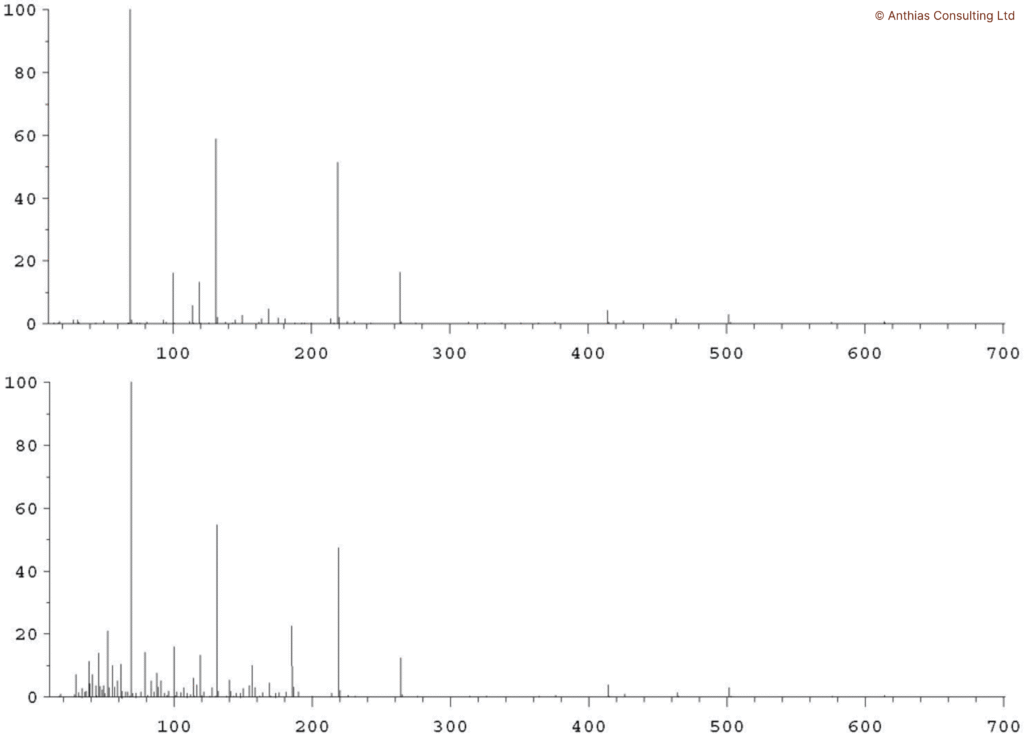
- What does the typical output, for example a chromatogram or (mass) spectrum, look like for this analysis? After ensuring that the instrument is in good health it is important to check that it is working optimally for this method before analysing any samples. Analysing a standard like an AQC or system suitability check can be used to assess this and a quick comparison can be made (Figure 1). Depending on the technique that you are using, peak separation, peak shape, relative ratios of the analytes, signal-to-noise or -background ratios, are all checks that could be performed.
- Storing this standard in the freezer means it can be re-run to identify if a problem is the standard, a sample or the instrument.
- Keep a copy of all method conditions. Methods have been known to get corrupted, even back-up electronic copies! Therefore a hard copy or a PDF of a method kept on a different PC is important. Worst case scenario you can create a new method and type in the parameters!
- Ensure to have a detailed list of all consumables that the method relies upon. For example, the wrong GC inlet liner can have a massive effect on the results.
Collecting this information together into an easily accessible format (sometimes a hardcopy of, for example a baseline trace, in a file next to the instrument) means that it is available for daily maintenance and checks as well as in the event troubleshooting needs to be quickly performed. A schematic of the instrument set-up for the method can also be useful for troubleshooting purposes, to help breakdown the system into modules then working through them (conceptually and/or physically) to identify the source of the problem.
To learn more about troubleshooting, attend:
- Applied GC and GC-MS maintenance and troubleshooting, day five or module twelve Applied GC and GC-MS troubleshooting of our Complete GC and GC-MS
- Hands-on GC and GC-MS troubleshooting, day five of our Hands-on GC and GC-MS
- Comprehensive GC hardware (Agilent GC)
- Comprehensive GC hardware (Shimadzu GC)
- Comprehensive GC hardware (Thermo GC)
- Comprehensive GC hardware (Scion/Bruker/Varian GC)
- Applied LC and LC-MS maintenance and troubleshooting, day five or module twelve Applied LC and LC-MS troubleshooting of our Complete LC and LC-MS
- Hands-on LC and LC-MS troubleshooting, day five of our Hands-on LC and LC-MS
- Applied AAS
- Applied ICP-MS
- Applied ICP-MS/MS
- Applied ICP-OES
- Hands-on FTIR
- Hands-on UV-Vis
- Applied FTIR
- Applied UV-Vis
Don’t forget that you can also subscribe to our newsletters and receive useful tips straight to your inbox!


