
Applied GC and GC-MS maintenance and troubleshooting

- Duration: 1 day for live courses
- Experience level: Intermediate
- Delivery methods: Face-to-face | Offsite training & consultancy | On-Demand | Online | Onsite training & consultancy | Tailored training |
- Type of course: Universal
- Applicable to manufacturer(s): Agilent | Bruker | CDS Analytical | CTC analytics | Frontier | GERSTEL | GL Sciences | Leco | OI Analytical | PerkinElmer | Scion | Shimadzu | SRI | Thermo | Varian | Waters |
- CPD Approved: Approved
- Scheduled course price: £425.00 + TAX per delegate
- Course discounts: RSC CAMS HEaTED Cambridge Network members receive a discount on this course
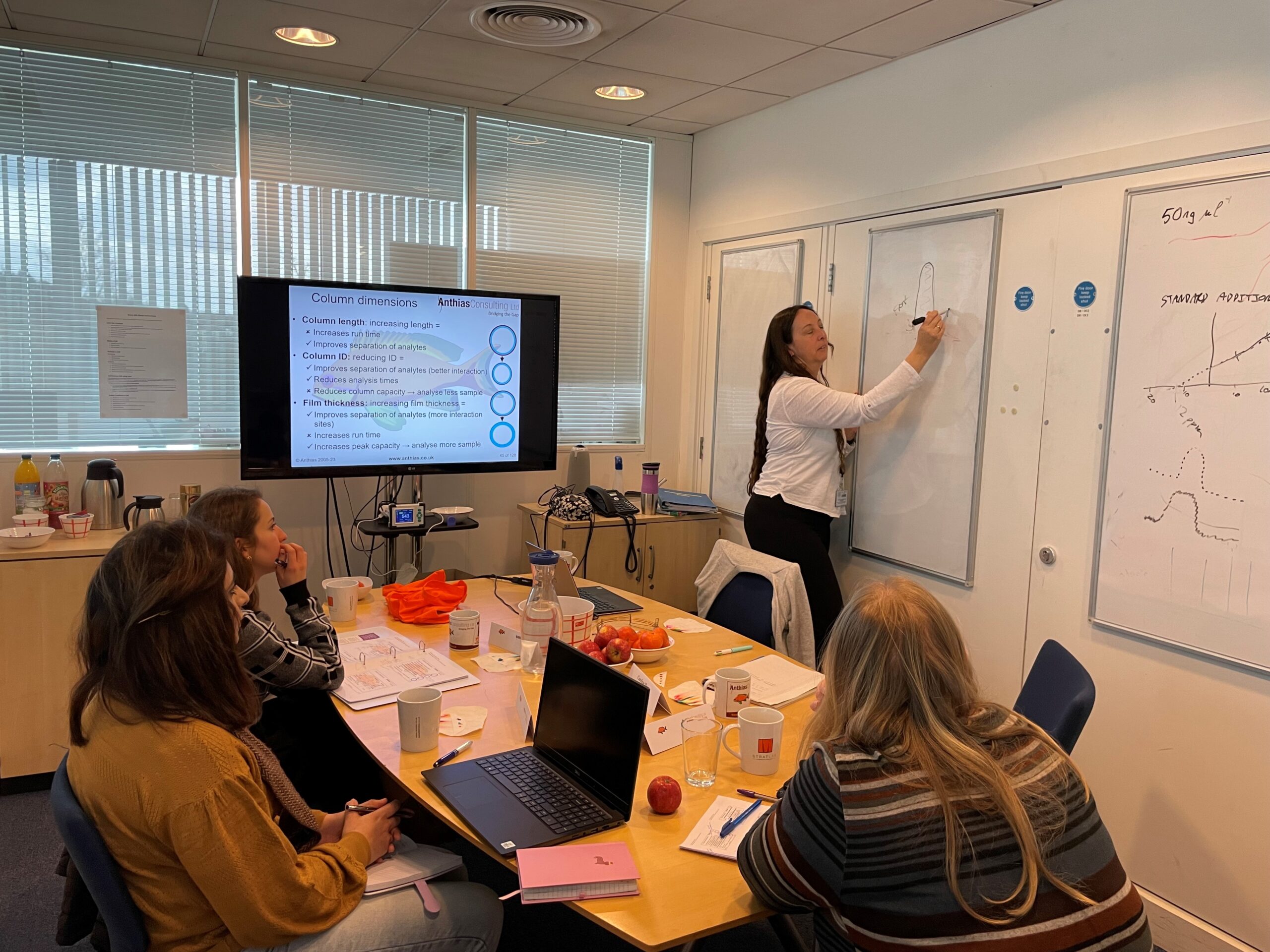
Your applied guide to maintaining, diagnosing, and troubleshooting gas chromatography (GC) and GC-mass spectrometry (GC-MS) systems
Day 5 and Modules 11 and 12 of the Complete GC & GC-MS and The GC & GC-MS Clinic course.
Applied GC and GC-MS maintenance and troubleshooting is approved by the Royal Society of Chemistry (RSC) for the purposes of Continuing Professional Development (CPD), and provides an in-depth exploration of GC and GC-MS maintenance and troubleshooting. Designed for professionals, students, and chemists wishing to maximise instrument performance, reliability, and uptime, this training provides the practical theory needed to maintain analytical systems in optimum condition while rapidly resolving common and complex analytical problems.
This day and modules can be combined with any of the other twelve modules and days in the Complete GC and GC-MS course to tailor your training needs.
Why should I join?
On completion of Day 5 training, you will gain an understanding of maintenance and troubleshooting strategies for GC and GC-MS, giving you:
- An overview of preventative maintenance strategies for GC and GC-MS systems
- Understanding of how contamination, leaks, consumable wear, and poor gas quality affect analytical performance
- Insight into maintenance requirements for autosamplers, inlets, columns, detectors, mass spectrometers, and vacuum systems
- A structured and logical approach to diagnosing GC and GC-MS problems
- Understanding of how instrument components interact and influence chromatographic and mass spectrometric performance
- Insight into troubleshooting peak shape abnormalities, baseline instability, retention time shifts, and reproducibility issues
- An excellent addition to other modules and days within the Complete GC and GC-MS training programme
What would I learn?
This day focuses on maintaining reliable GC and GC-MS operation and solving common analytical problems, you will learn:
- The critical components of a GC and GC-MS system and how they interact to produce reliable analytical results
- How to maintain gas cylinders, regulators, gas lines, traps, filters, and plumbing systems to ensure high-purity gas delivery
- The maintenance requirements of liquid autosamplers, headspace samplers, thermal desorption systems, pyrolysers, and purge-and-trap systems
- How to clean, trim, install, condition, regenerate, and troubleshoot capillary columns
- The maintenance requirements of common GC detectors and GC-MS components including vacuum pumps, ion sources, filaments, mass analysers, and electron multipliers
- A logical troubleshooting workflow including problem identification, symptom evaluation, fault isolation, corrective action, verification, and prevention
- How to distinguish between sample-related, method-related, instrument-related, and data-related problems
- The interpretation of tune reports, air and water checks, chromatograms, and system suitability results during troubleshooting investigations
- How to investigate peak tailing, fronting, distortion, broadening, ghost peaks, and retention time shifts
What knowledge will I gain?
By the end of the day, you will:
- Understand how preventative maintenance reduces instrument downtime and improves analytical performance
- Be able to identify common causes of contamination, sensitivity loss, baseline instability, poor reproducibility, and increased noise
- Know when critical consumables such as septa, liners, ferrules, filters, traps, and columns should be replaced
- Be able to correctly install, trim, condition, and maintain capillary columns for optimum performance
- Know when ion source cleaning, filament replacement, tuning, or vacuum maintenance may be required
- Understand how tune reports and air and water checks can be used to evaluate GC-MS performance and identify faults
- Be able to apply a systematic troubleshooting process that reduces unnecessary maintenance and component replacement
- Recognise common chromatographic issues including tailing, fronting, broadening, distortion, carryover, and ghost peaks
- Know the causes of retention time shifts and how to diagnose issues related to leaks, blockages, temperature control, column ageing, and matrix effects
Is this course for me?
This day is designed for anyone who would like to learn more about maintaining and troubleshooting GC and GC-MS systems.
- Laboratory analysts & technicians using GC and GC-MS
- Laboratory or line managers overseeing GC and GC-MS instruments and analysis
- Data analysts and report writers who work with GC and GC-MS data
- Service engineers who want a chemistry-focused introduction to GC and GC-MS maintenance and troubleshooting
- Scientists responsible for instrument performance, maintenance, troubleshooting, and laboratory productivity
- Sales, commercial, or marketing teams who work with GC and GC-MS components, instruments, services, or personnel and would like more knowledge
If GC or GC-MS touches your work in any way, this well-planned training day, delivered by experts in the field, equips you with the knowledge to understand these techniques.
This course includes
Select the courses you are interested in:
Feedback from previous attendees
“Course content was very interesting and relevant to anyone hoping to expand their GC-MS knowledge.
Lots to learn and apply to all different types of analysis. High standard of knowledge and how things should be done!” feedback from The GC & GC-MS Clinic (October 2020).“Being able to hear from an expert in the field and see some practical examples. I was given a lot of base knowledge and loads of helpful tips that I would never have thought about.” Hollie Gillespie, QC Lab Analyst, NextGEN360 (May 2020).
“It was good to be able to have an outline of how to deal with problems when they first appear. Lots of useful tips were included alongside the more basic information. [Most useful topic:] Chromatogram Troubleshooting. It was really useful to be able to apply the knowledge given in the training and see some real examples.” Hollie Gillespie, QC Lab Analyst, NextGEN360 (May 2020).
“[The instructor] was extremely knowledgeable and it showed. She was able to answer any question thrown at her.” Feedback from the GC & GC-MS Troubleshooting & Maintenance Short Course at Pittcon 2019.
“A lot of practical information providing good starting points. [Instructor] very knowledgeable about all aspects. Very helpful, upbeat, and friendly.” Feedback from the GC & GC-MS Troubleshooting & Maintenance Short Course at Pittcon 2019.
“The instructor was extremely knowledgeable. The course was interactive. The instructor made sure that each student had an opportunity to explain what they wanted from the course and the individuals concerns were covered and explained. She did a wonderful job!! Feedback from the GC & GC-MS Troubleshooting & Maintenance Short Course at Pittcon 2019.
“I thought the way this course was presented made it very easy to follow. I liked the troubleshooting in the afternoon a lot also. Feedback from the GC & GC-MS Troubleshooting & Maintenance Short Course at Pittcon 2019.
“The practical examples (including chromatograms), were extremely beneficial to help retain the info for the class.” Feedback from the GC & GC-MS Troubleshooting & Maintenance Short Course at Pittcon 2019.
“Wide range of details, excellent tips and tricks, very useful information.” Feedback from the GC & GC-MS Troubleshooting & Maintenance Short Course at Pittcon 2019.
“Diane was extremely knowledgeable and personable.” Feedback from the GC & GC-MS Troubleshooting & Maintenance Short Course at Pittcon 2019.
“Smart, sensible breakdown of an optimal troubleshooting approach.” Feedback from the GC & GC-MS Troubleshooting & Maintenance Short Course at Pittcon 2019.
“All the information was given in a clear and very professional manner and the course will really help me to identify problems I might encounter in the future. All questions were answered and good examples and solutions to problems given. All topics covered were useful and interesting + we had a tour of the lab!” Katiuska Caraballo, Analytical Chemist at South East Water, attended Troubleshooting & Maintenance individual day of the Complete GC & GC-MS course (July 2012).


