
Applied GC and GC-MS method development and advanced techniques

- Duration: 1 day for live courses
- Experience level: Intermediate
- Delivery methods: Face-to-face | Offsite training & consultancy | On-Demand | Online | Onsite training & consultancy | Tailored training |
- Type of course: Manufacturer specific
- Applicable to manufacturer(s):
- CPD Approved: Approved
- Scheduled course price: £425.00 + TAX per delegate
- Course discounts: RSC CAMS HEaTED Cambridge Network members receive a discount on this course
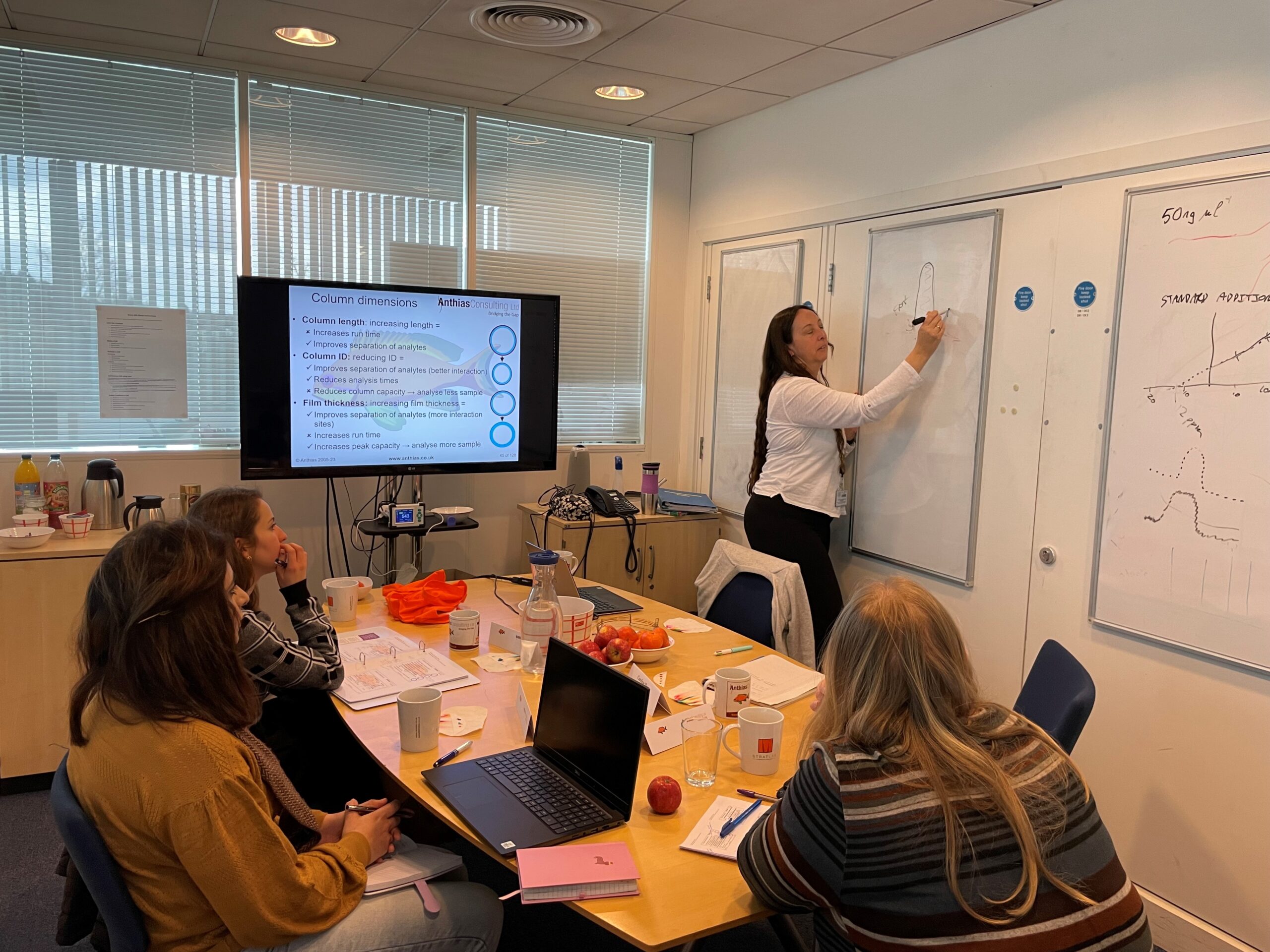
Your applied guide to method development and advanced analytical techniques for gas chromatography (GC) and GC-mass spectrometry (GC-MS)
Day 4 and modules 9 and 10 of the Complete GC & GC-MS and The GC & GC-MS Clinic course.
Applied GC and GC-MS method development and advanced techniques is approved by the Royal Society of Chemistry (RSC) for the purposes of Continuing Professional Development (CPD), and provides an in-depth exploration of GC and GC-MS method development alongside advanced analytical techniques used in modern laboratories. Designed for professionals, students, and chemists wishing to expand their theoretical understanding of GC and GC-MS, this training provides both the foundations of effective method development and an introduction to advanced techniques used when conventional approaches may no longer be sufficient.
This day and modules can be combined with any of the other twelve modules and days in the Complete GC and GC-MS course to tailor your training needs.
Why should I join?
On completion of day 4 training, you will gain an understanding of GC and GC-MS method development and advanced analytical techniques, giving you:
- An overview of the complete GC and GC-MS method development process from concept through to validation
- Understanding of how analytical objectives influence method design, instrument selection, and analytical performance
- Practical guidance on troubleshooting chromatographic and mass spectrometric challenges
- Understanding of advanced mass spectral interpretation techniques for structural elucidation and compound identification
- Insight into selective discrimination and selective transfer approaches for enhancing sensitivity and reducing matrix interferences
- An introduction to fast GC, multidimensional GC, deconvolution, and chemometric data analysis techniques
- An excellent addition to other modules and days within the Complete GC and GC-MS training programme
What would I learn?
This day focuses on method development and advanced analytical techniques for GC and GC-MS, you will learn:
- How to define analytical objectives and develop a structured workflow for method development
- How sampling, storage, transportation, and sample preparation influence analytical performance
- How to select and optimise sampling and injection techniques including split, splitless, on-column, and large-volume injection
- How carrier gas selection, flow rates, inlet conditions, and temperature programming influence chromatographic performance
- The principles of column selection, including stationary phase chemistry, film thickness, internal diameter, and column length
- How fragmentation patterns, molecular ions, and isotope abundances can be used for mass spectral interpretation and compound identification
- How fast GC strategies can increase sample throughput while maintaining analytical quality
- How multidimensional GC techniques such as heart-cutting GC and GC×GC increase separation power and analytical capability
- How chemometric techniques can be applied to identify trends, classify samples, detect outliers, and interpret complex datasets
What knowledge will I gain?
By the end of the day, you will:
- Understand the complete process of developing a GC or GC-MS method from analytical objectives through to final validation
- Be able to identify and optimise the critical parameters that influence analytical performance
- Know how to develop methods for challenging analytes, including thermally labile, active, trace-level, and high molecular weight compounds
- Understand calibration strategies, limits of detection and quantitation, and method performance requirements
- Gain insight into quality assurance tools including blanks, spikes, internal standards, surrogate standards, and system suitability testing
- Be able to interpret mass spectra using fragmentation pathways, isotope patterns, and molecular ion information
- Understand the strengths and limitations of advanced tools such as deconvolution software, selective discrimination, and fast GC
- Know when multidimensional GC techniques are appropriate and how they can improve analytical separations
- Understand how GC×GC provides enhanced separations based on multiple physicochemical properties including volatility and polarity
Is this course for me?
This day is designed for anyone who would like to learn more about GC and GC-MS method development and advanced analytical techniques.
- Laboratory analysts & technicians using GC and GC-MS
- Laboratory or line managers overseeing GC and GC-MS instruments and analysis
- Data analysts and report writers who work with GC and GC-MS data
- Service engineers who want a chemistry-focused introduction to advanced GC and GC-MS applications
- Scientists responsible for developing, optimising, validating, or troubleshooting analytical methods
- Sales, commercial, or marketing teams who work with GC and GC-MS components, instruments, services, or personnel and would like more knowledge
If GC or GC-MS touches your work in any way, this well-planned training day, delivered by experts in the field, equips you with the knowledge required understand these techniques.
This course includes
Select the courses you are interested in:
Feedback from previous attendees
“Course content was very interesting and relevent to anyone hoping to expand their GC-MS knowledge.
Lots to learn and apply to all different types of analysis. High standard of knowledge and how things should be done!” feedback from The GC & GC-MS Clinic (October 2020).“Detailed explanations and useful tips.” (April 2019).
“Richard was really nice and friendly and explained everything really well.” (April 2019).
“Excellent instructor; very thorough and knowledgeable; able to provide in depth details.” Feedback from the GC & GC-MS Method Development Short Course at Pittcon 2019 (the first session of the 1-day GC & GC-MS Method Development and Advanced Techniques course).
“The most useful thing was learning where to start, especially with unknown samples, and how to optimize from there. Feedback from the GC & GC-MS Method Development Short Course at Pittcon 2019 (the first session of the 1-day GC & GC-MS Method Development and Advanced Techniques course).
“Instructor had a deep understanding of material – truly an expert with experiences to share.” Feedback from the GC & GC-MS Method Development Short Course at Pittcon 2019 (the first session of the 1-day GC & GC-MS Method Development and Advanced Techniques course).
“Instructor did an excellent job describing techniques, methods, and applications. Great coverage of questions from students.” Feedback from the GC & GC-MS Method Development Short Course at Pittcon 2019 (the first session of the 1-day GC & GC-MS Method Development and Advanced Techniques course).
“Very knowledgeable – awesome. So many great tips were given!” Feedback from the GC & GC-MS Method Development Short Course at Pittcon 2019 (the first session of the 1-day GC & GC-MS Method Development and Advanced Techniques course).


