
Applied LC and LC-MS method development
- Duration: 5.50 hours for on-demand
- Experience level: Intermediate
- Delivery methods: Offsite training & consultancy | On-Demand | Online | Onsite training & consultancy | Tailored training |
- Type of course: Universal
- Applicable to manufacturer(s): Agilent | Bruker | CTC analytics | JASCO | PerkinElmer | Sciex | Scion | Shimadzu | Thermo | Waters |
- CPD Approved: Approved
- Scheduled course price: £357.50 + TAX per delegate
- Course discounts: RSC CAMS HEaTED Cambridge Network members receive a discount on this course
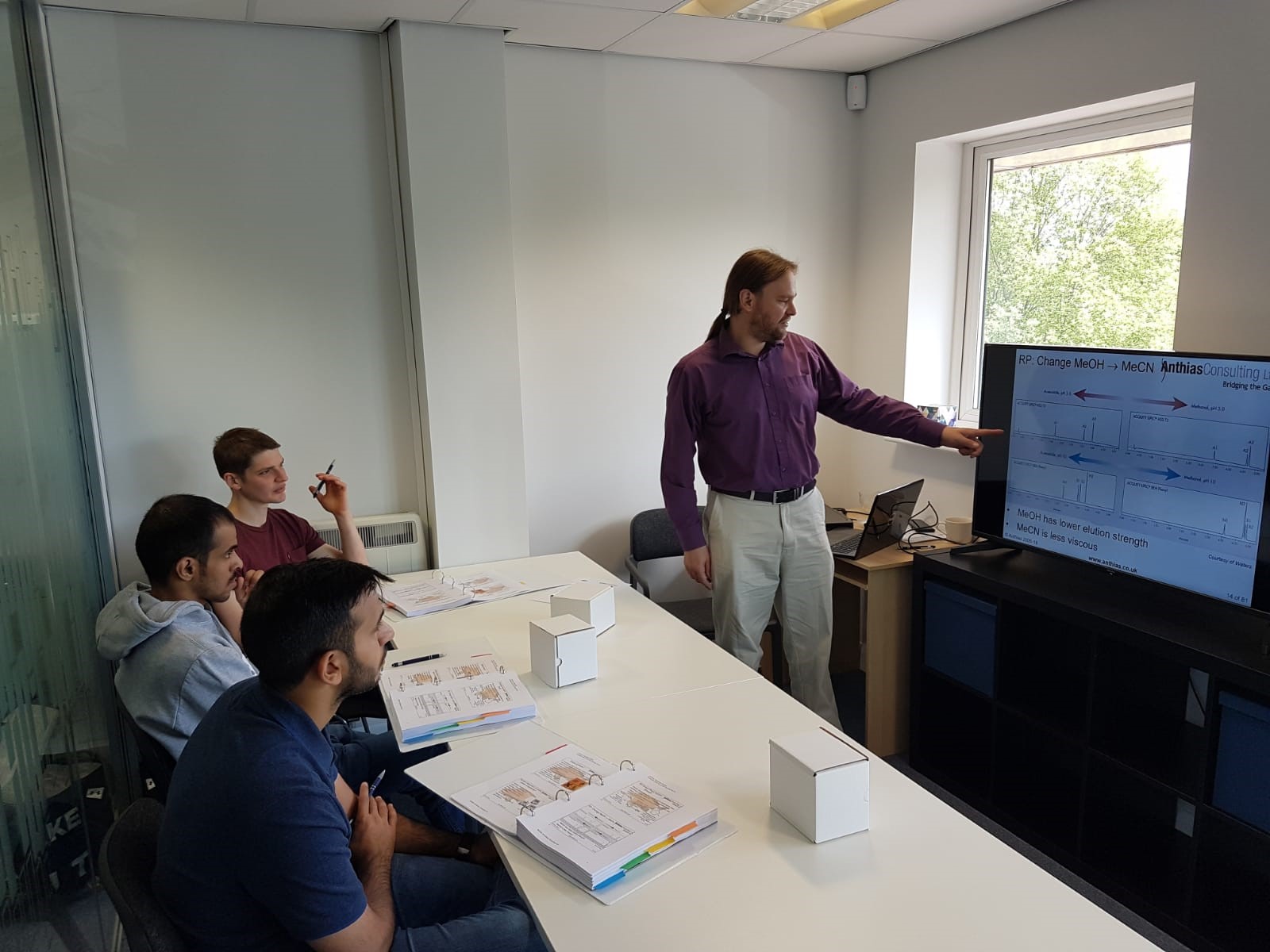
Your applied guide to developing liquid chromatography (LC) and liquid chromatography-mass spectrometry (LC-MS) methods
Module 9 of the Complete LC and LC-MS course and module 1 of The LC and LC-MS Clinic course
Applied LC and LC-MS method development is approved by the Royal Society of Chemistry (RSC) for the purposes of Continuing Professional Development (CPD). Designed for professionals, students and chemists, this module provides an in-depth exploration of LC and LC-MS method development, covering the complete analytical workflow from defining analytical objectives and selecting instrumentation, through to optimisation, validation, quality assurance, and accreditation requirements.
This module can be combined with any of the other twelve modules in the Complete LC and LC-MS course to tailor your training needs.
Why should I join?
On completion of this module 9 training, you will be able to develop a structured approach to LC and LC-MS methodology, giving you:
- An overview of the LC and LC-MS method development process
- Understanding of how analytical objectives influence method design, detector selection, and workflow decisions
- Insight into optimisation strategies for sampling, sample preparation, injection, separation, detection, and data acquisition
- Practical guidance on troubleshooting chromatographic and mass spectrometric challenges
- A detailed understanding of method performance characteristics including accuracy, precision, linearity, robustness, and detection limits
What would I learn?
This module focuses on the design, development and optimisation of LC and LC-MS methods. You will learn:
- How to define analytical objectives and determine the most appropriate analytical approach
- How to plan and structure a logical LC and LC-MS method development workflow
- The importance of sampling, sample handling, storage, transportation, and sample preparation in overall method performance
- How to optimise sample preparation techniques including SPE, LLE, filtration, concentration and clean-up procedures
- The principles of column selection, including stationary phase chemistry, particle size, pore size, column dimensions, and chiral separations
- How to develop and optimise isocratic and gradient LC methods for complex mixtures
- How to optimise detector performance for UV-Vis, fluorescence, and mass spectrometric detection systems
What knowledge will I gain?
By the end of the module, you will:
- Understand the complete process of developing an LC or LC-MS method from initial concept through to routine application
- Be able to identify the most critical variables affecting chromatographic resolution, sensitivity, and robustness
- Understand how to optimise sample preparation, injection, separation, and detection parameters systematically
- Know how to select the most appropriate columns, mobile phases, detectors, ionisation techniques and mass analysers for specific applications
- Understand how to maximise sensitivity while minimising matrix effects, carryover, contamination, and analyte losses
- Understand the factors affecting chromatographic resolution
- Know how to assess and improve method performance
- Understand calibration strategies and the determination of limits of detection, quantitation and reporting
- Gain insight into quality assurance procedures including blanks, spikes, replicates, internal standards and surrogate standards
Is this course for me?
This course is designed for anyone who would like to learn method development for LC and LC-MS techniques.
- Laboratory analysts and technicians using LC, HPLC, UHPLC and LC-MS systems
- Laboratory or line managers responsible for LC and LC-MS instrumentation and data quality
- Data analysts and report writers working with LC and LC-MS data
- Service engineers who would benefit from a chemistry-focused introduction to LC and LC-MS method optimisation
- Sales, commercial and marketing teams working with LC, LC-MS, consumables, instrumentation and analytical services
If LC and LC-MS touches your work in any way, this well-planned course delivered by experts in the field equips you with the knowledge needed to understand the science behind these techniques.
Select the courses you are interested in:
Feedback from previous attendees
“This module was good as it re-visited other stuff previously covered in the course but then applied the theory to method development.” Joe Richardson, Assistant Scientist, Environment Agency (November 2020).


