
Practical Essentials of GC and GC-MS data analysis and sample preparation

- Duration: 1 day for live courses 6.25 hours for on-demand
- Experience level: Intermediate
- Delivery methods: Face-to-face | Offsite training & consultancy | On-Demand | Online | Onsite training & consultancy | Tailored training |
- Type of course: Universal
- Applicable to manufacturer(s): Agilent | Bruker | CDS Analytical | CTC analytics | Frontier | GERSTEL | GL Sciences | Leco | OI Analytical | PerkinElmer | Pyrolab | Scion | Shimadzu | SRI | Thermo | Varian | Waters |
- CPD Approved: Approved
- Scheduled course price: £425.00 + TAX per delegate
- Course discounts: RSC CAMS HEaTED Cambridge Network members receive a discount on this course
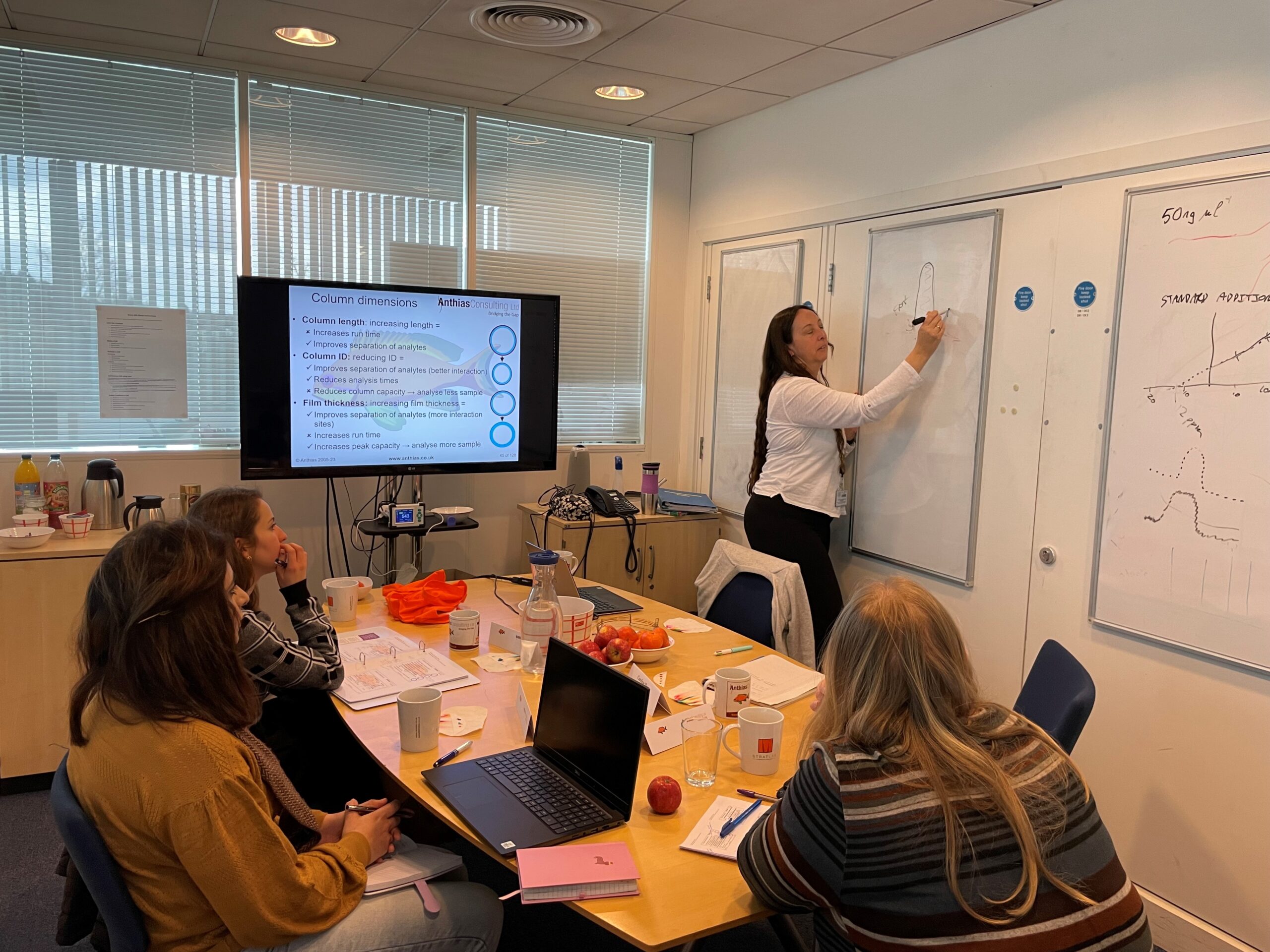
Your essential guide to data analysis and sampling techniques for gas chromatography (GC) and GC-mass spectrometry (GC-MS)
Day 3 and Modules 7 and 8 of the Complete GC & GC-MS and the Practical Essentials of GC & GC-MS course.
Practical Essentials of GC and GC-MS data analysis and sample preparation is approved by the Royal Society of Chemistry (RSC) for the purposes of Continuing Professional Development (CPD), and is a classroom-based course that provides an in-depth exploration of GC and GC-MS data analysis, covering processing, qualitative identification and calibration strategies. Followed by a focus on sampling, sample preparation and extraction techniques used in GC and GC-MS, examining one of the most critical stages of both analytical techniques. Designed for professionals, students and chemists wanting to take the next step to enhancing their GC and GC-MS knowledge.
This day and modules can be combined with any of the other twelve modules and days in the Complete GC and GC-MS to tailor your training needs.
Why should I join?
On completion of day 3 training, you will gain understanding of data analysis, sampling and sample preparation associated with GC and GC-MS, giving you:
- An overview of data processing and integration principles
- Understanding of how integration parameters influence peak area calculations and analytical accuracy
- Insight into signal-to-noise ratios, baseline placement, smoothing, and background subtraction
- Understanding of how sample properties influence the selection of extraction and introduction techniques
- Insight into automated liquid injection systems, syringe selection, filtration, and sample handling
- An excellent addition to other modules and days in our Complete GC and GC-MS training
- A great refresher if you have not worked with GC or GC-MS for a while
What would I learn?
This day focuses on the aspects of data analysis, sampling and sampling techniques for GC and GC-MS:
- How chromatographic and spectral data is acquired, processed, and integrated by modern data systems
- The role of integrators and how peak start, peak apex, peak end, area, height, and width are determined
- Different approaches for integrating co-eluting peaks, including drop line, tangent skim, and valley-to-valley integration
- How to select the most appropriate sampling strategy based on sample type, analyte properties, and analytical objectives
- The principles, benefits, and applications of derivatisation techniques including alkylation, silylation, and acylation
- How thermal extraction techniques such as thermal desorption, analytical pyrolysis, and headspace analysis are used for sample preparation
- How analytical pyrolysis can be used to investigate complex, non-volatile materials and degradation products
What knowledge will I gain?
By the end of the day, you will:
- Understand how data analysis parameters influence chromatographic accuracy, precision, and reproducibility
- Be able to optimise integration settings to minimise errors and improve automated data processing
- Understand how baseline noise, signal-to-noise ratio, and peak resolution affect quantitative measurements
- Know how to evaluate and integrate overlapping peaks using appropriate baseline allocation techniques
- Understand how sample phase, analyte volatility, matrix composition, and sampling location influence technique selection
- Be able to select suitable sample preparation methods for gases, liquids, solids, and complex matrices
- Gain insight into method development strategies for volatile, semi-volatile, and non-volatile analytes
- Develop the knowledge needed to choose and optimise sample preparation techniques for a wide range of analytical applications
Is this course for me?
This day is designed for anyone who would like to learn and know about data analysis and sampling techniques for GC and GC-MS.
- Laboratory analysts & technicians using GC and GC-MS
- Laboratory or line managers overseeing GC and GC-MS instruments and analysis
- Data analysts and report writers who work with GC and GC-MS data
- Service engineers who want a chemistry focused introduction
- Sales, commercial or marketing teams who work with GC and GC-MS components, instruments, services or personnel in any way and would like more knowledge
If GC or GC-MS touches your work in any way, this well-planned module, delivered by experts in the field, equips you to understand the science behind these analytical chemistry techniques.
Select the courses you are interested in:
Feedback from previous attendees
“Detailed explanations and useful tips.” (April 2019).
“Richard was really nice and friendly and explained everything really well.” (April 2019).


