
Practical Essentials of GC and GC-MS data analysis

- Duration: 2 hours for on-demand
- Experience level: Intermediate
- Delivery methods: Offsite training & consultancy | On-Demand | Online | Onsite training & consultancy | Tailored training |
- Type of course: Universal
- Applicable to manufacturer(s): Agilent | Bruker | CDS Analytical | CTC analytics | Frontier | GERSTEL | GL Sciences | Leco | OI Analytical | PerkinElmer | Scion | Shimadzu | SRI | Thermo | Varian | Waters |
- CPD Approved: Approved
- Scheduled course price: £130.00 + TAX per delegate
- Course discounts: RSC CAMS HEaTED Cambridge Network members receive a discount on this course
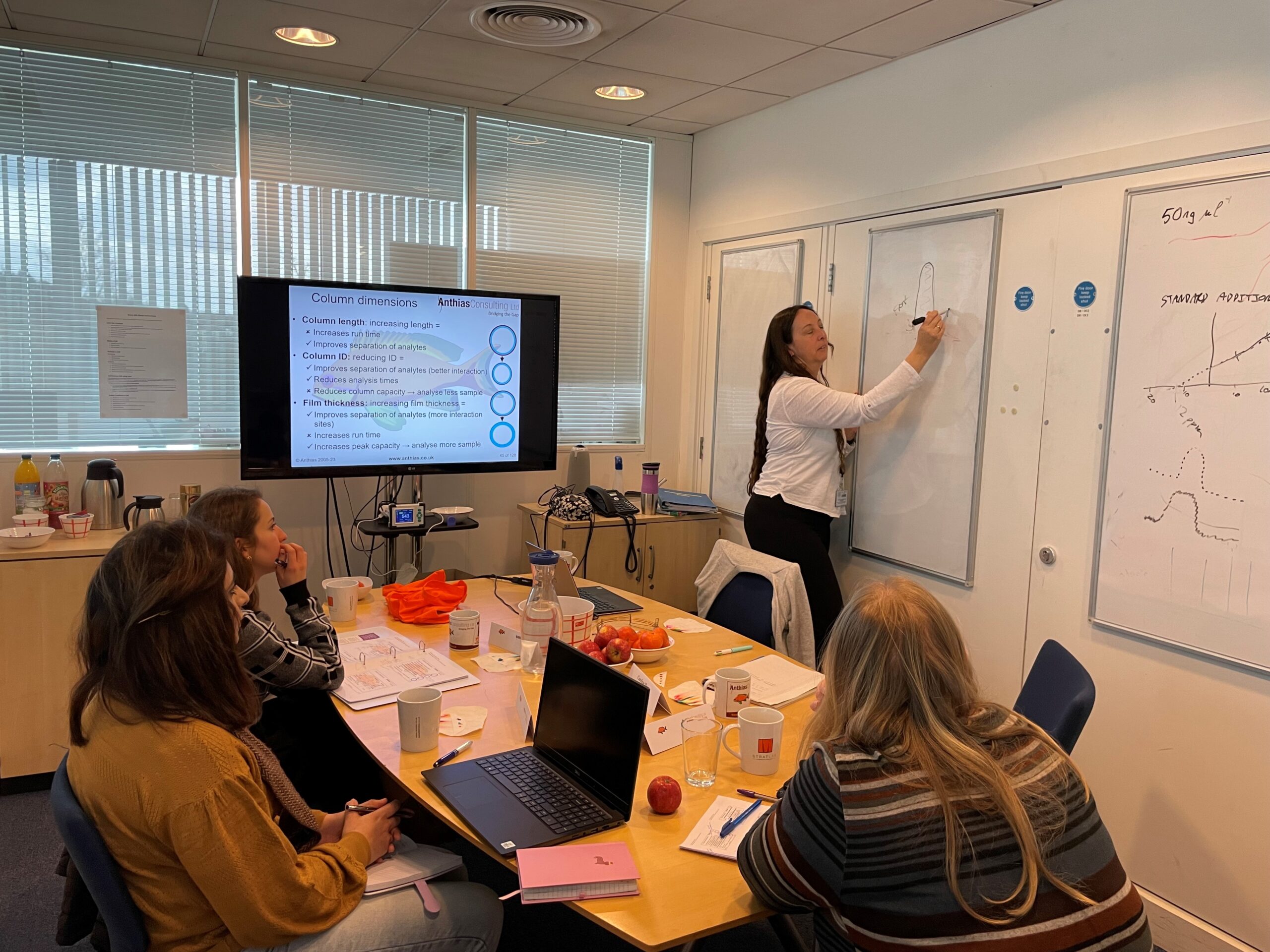
Your essential guide to data analysis for gas chromatography (GC) and GC-mass spectrometry (GC-MS)
Module 7 of the Complete GC and GC-MS and the Practical Essentials of GC and GC-MS course.
Practical Essentials of GC and GC-MS data analysis module is approved by the Royal Society of Chemistry (RSC) for the purposes of Continuing Professional Development (CPD). This course designed for professionals, students and chemists, provides an in-depth exploration of GC and GC-MS data analysis, covering data processing, peak integration, qualitative identification, quantitative calculations, calibration strategies, and reporting. You will learn how to transform chromatographic and mass spectral data into accurate, reliable analytical results and how to optimise data analysis methods to improve confidence in your findings.
This module can be combined with any of the other twelve modules in the Complete GC and GC-MS to tailor your training needs.
Why should I join?
On completion of this module 7 training, you will gain an understanding of how chromatographic and mass spectrometry data is processed, interpreted, and reported, giving you:
- An overview of data processing and integration principles
- Understanding of how integration parameters influence peak area calculations and analytical accuracy
- Insight into signal-to-noise ratios, baseline placement, smoothing, and background subtraction
- Knowledge of qualitative identification using retention times, retention indices, and mass spectral library searching
- A detailed understanding of quantitative analysis methods, calibration strategies, and response factor calculations
- A valuable refresher for analysts seeking to improve data quality, reduce errors, and increase confidence in reported results
What would I learn?
This module focuses on the aspects of handling, interpreting, and reporting GC and GC-MS data, you will learn:
- How chromatographic and spectral data is acquired, processed, and integrated by modern data systems
- The role of integrators and how peak start, peak apex, peak end, area, height, and width are determined
- Different approaches for integrating co-eluting peaks, including drop line, tangent skim, and valley-to-valley integration
- The use of dynamic background compensation (DBC) algorithms to improve and mass spectral quality
- How retention times, retention indices, and mass spectra are used to identify known and unknown compounds
- The principles of mass spectral library searching, including forward and reverse search techniques
- Quantitative methods including area percent, external standard and internal standard use, standard addition, and semi-quantitative approaches
What knowledge will I gain?
By the end of the module, you will:
- Understand how data analysis parameters influence chromatographic accuracy, precision, and reproducibility
- Be able to optimise integration settings to minimise errors and improve automated data processing
- Understand how baseline noise, signal-to-noise ratio, and peak resolution affect quantitative measurements
- Know how to evaluate and integrate overlapping peaks using appropriate baseline allocation techniques
- Be able to use retention indices to improve compound identification and distinguish challenging isomeric compounds
- Understand the strengths and limitations of mass spectral library searches and how to critically assess search results
- Know how to construct and evaluate calibration curves, including curve fitting, weighting, and detector response considerations
Is this course for me?
This course is designed for anyone who would like to learn data analysis for both techniques.
- Laboratory analysts & technicians using GC and GC-MS
- Laboratory or line managers overseeing GC and GC-MS instruments and analysis
- Data analysts and report writers who work with GC and GC-MS
- Service engineers who want chemistry focused introduction to GC and GC-MS
- Sales, commercial or marketing teams who work with GC and GC-MS components, instruments, or services in anyway and would like more in-depth knowledge
If GC and GC-MS touches your work in any way, this well-planned course delivered by experts in the field equips you to understand the science behind these techniques.
Select the courses you are interested in:
Feedback from previous attendees
“I enjoyed that this module material covers all methods and detailed the why, how and the importance of each, as well as listed the pros and cons of each method.” July 2020


