
Practical Essentials of LC mobile phases and pumps

- Duration: 2.50 hours for on-demand
- Experience level: Intermediate
- Delivery methods: Offsite training & consultancy | On-Demand | Online | Onsite training & consultancy | Tailored training |
- Type of course: Universal
- Applicable to manufacturer(s): Agilent | Bruker | CTC analytics | JASCO | PerkinElmer | Sciex | Scion | Shimadzu | Thermo | Waters |
- CPD Approved: Approved
- Scheduled course price: £162.50 + TAX per delegate
- Course discounts: RSC CAMS HEaTED Cambridge Network members receive a discount on this course
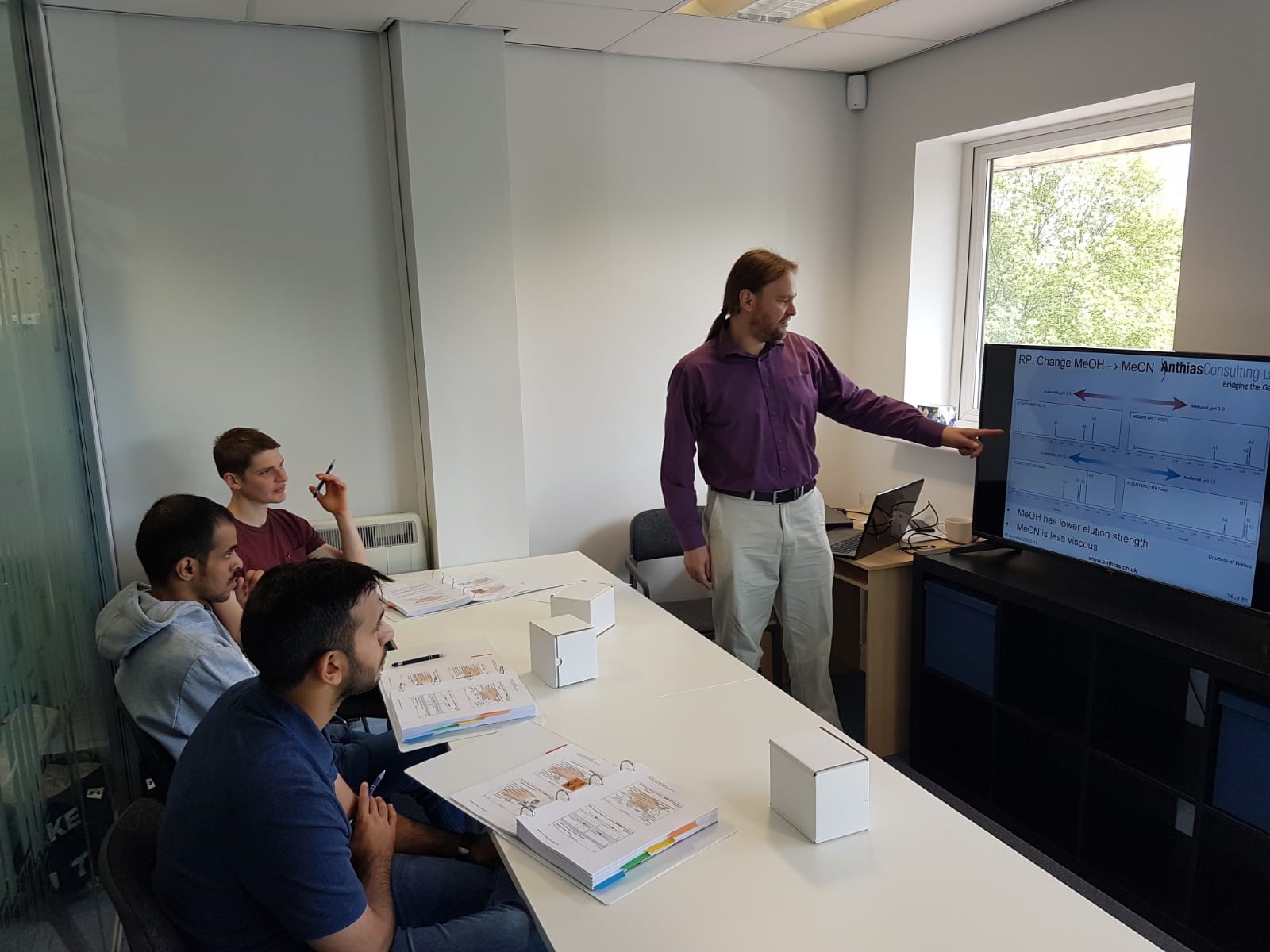
Your essential guide to mobile phases and pumps for liquid chromatography (LC)
Module 2 of the Complete LC & LC-MS and the Practical Essentials of LC & LC-MS course.
Practical Essentials of LC mobile phases and pumps is approved by the Royal Society of Chemistry (RSC) for the purposes of Continuing Professional Development (CPD). Take an in-depth approach to mobile phase selection, preparation, buffer chemistry, and liquid chromatography pumping systems used in modern LC and LC-MS analysis. This training is designed for professionals, students and chemists who want to enhance their understanding of mobile phases, buffers and pumping technology used in LC and LC-MS.
This module can be combined with any of the other twelve modules in the Complete LC & LC-MS programme to tailor your training needs.
Why should I join?
On completion of this Module 2 training, you will have a solid understanding of mobile phases, buffers and LC pumping systems, giving you:
- An overview of the different mobile phases used in LC
- Clear explanations of normal phase and reversed phase solvent selection
- Understanding of mobile phase preparation, filtering and degassing requirements
- An overview of buffer selection and pH control in chromatographic separations
- How isocratic and gradient pumping systems influence separation performance
- A great addition to the other modules in our Complete LC & LC-MS programme
- A valuable refresher on LC mobile phases and pumps if you have not used LC for a while
What would I learn?
This module focuses on explaining the importance of mobile phase chemistry and pumping systems in LC and LC-MS, where you will learn:
- The differences between normal phase and reversed phase chromatography
- How solvent strength influences analyte retention and separation
- How to select appropriate solvents for chromatographic and mass spectrometric applications
- Best practice for mobile phase preparation, filtration and degassing
- How buffers affect retention, selectivity and reproducibility
- The operation of LC pumps and the differences between isocratic and gradient elution
What knowledge will I gain?
By the end of the module, you will:
- Understand how mobile phase composition affects retention time, selectivity and chromatographic performance
- Know the advantages and limitations of common LC solvents including water, methanol, acetonitrile and tetrahydrofuran
- Understand how solvent properties can impact detector compatibility and LC-MS performance
- Know how to prepare, filter and degas mobile phases correctly for reliable analysis
- Be familiar with common LC pump configurations, including reciprocating piston and syringe pump systems
- Know the differences between isocratic and gradient elution methods and when each approach should be used
- Understand the principles of low-pressure and high-pressure mixing systems
- Appreciate the importance of pump priming, pulse dampening and routine pump maintenance for consistent chromatographic performance
Is this course for me?
This course is designed for anyone who would like to learn about mobile phases, buffers and pumping systems in LC and LC-MS analysis.
- Laboratory analysts and technicians using LC and LC-MS
- Laboratory or line managers overseeing LC and LC-MS instruments and analytical workflows
- Data analysts and report writers who work with LC and LC-MS data
- Service engineers seeking a chemistry-focused understanding of LC and LC-MS systems
- Sales, commercial or marketing teams who work with LC and LC-MS instruments, consumables or services and would like more in-depth knowledge
If LC or LC-MS touches your work in any way, this well-planned course, delivered by experts in the field, equips you to understand the science behind these techniques.
Select the courses you are interested in:
Feedback from previous attendees
“Good use for different ways of making mobiles phase. Some good do’s and don’t.” Mollie Nero, Project Scientist, Broughton Nicotine Services (February 2021).
“The info about reversed phase chromatography was good, it was detailed and gave lots of useful tips for use at work.” Joe Richardson, Assistant Scientist, Environment Agency (November 2020).
“[I enjoyed the] level of detail information presented.”
“Useful discussion. Better material and knowledge of the instructor is helpful.”
“Professional, high quality delivery, keep track on time.”
“The instructor is aware of all the LC-MS spectrometry. I found in this course useful materials.”
“[I enjoyed] developing an understanding of the applications and function of the equipment.”
“The HPLC & LC-MS training was good and I enjoyed it because I have learnt a lot.”


