
Practical Essentials of LC and LC-MS

- Duration: 3 days for live courses 18 hours for on-demand
- Experience level: Intermediate
- Delivery methods: Face-to-face | Offsite training & consultancy | On-Demand | Online | Onsite training & consultancy | Tailored training |
- Type of course: Universal
- Applicable to manufacturer(s): Agilent | Bruker | CTC analytics | JASCO | PerkinElmer | Sciex | Scion | Shimadzu | Thermo | Waters |
- CPD Approved: Approved
- Scheduled course price: £1,200.00 + TAX per delegate
- Course discounts: RSC CAMS HEaTED Cambridge Network members receive a discount on this course
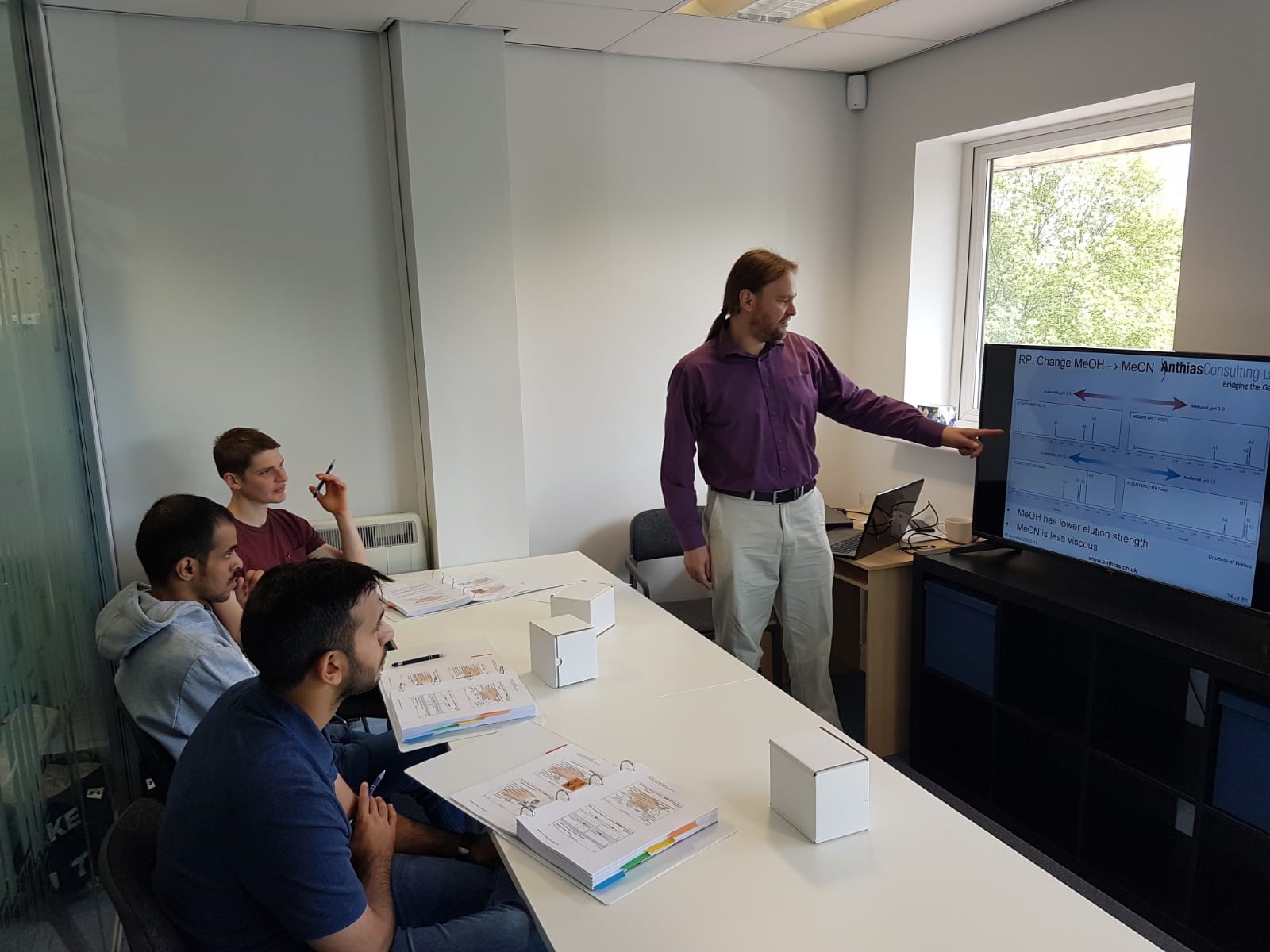
Your essential guide to liquid chromatography (LC) and liquid chromatography-mass spectrometry (LC-MS)
Days 1 to 3 of the Complete LC and LC-MS.
The Practical Essentials of LC & LC-MS training is approved by the Royal Society of Chemistry (RSC) for the purposes of Continuing Professional Development (CPD). This essential 3-day classroom-based training, designed for students, professionals and chemists, provides an in-depth understanding of LC and LC-MS, covering the theory, instrumentation, operation, optimisation and applications of modern chromatographic and mass spectrometric systems, taking participants through each stage of the analytical workflow, from knowing the principles of separation and instrument design, through to sample introduction, mobile phases and pumps and detector technologies available for LC and LC-MS analysis.
If you are looking to strengthen your understanding of LC and LC-MS, this course provides the knowledge and practical insight required to achieve reliable, high-quality analytical results. This course is packed full of examples and practical tips, as well as making full use of parts of the LC and LC-MS to handle (or see if virtual) including analytical columns, a quadrupole and turbo pump.
Why should I join?
By completing this LC and LC-MS training, you will develop a thorough understanding of how LC and LC-MS systems operate and how each component contributes to analysis, giving you:
- Understanding of LC and LC-MS instrumentation and analytical workflows
- Knowledge of mobile phase chemistry, solvent selection, buffer preparation, and pumping systems
- Understanding of sample introduction techniques and autosampler operation
- Insight into chromatographic theory, classifications, column technologies, and separation mechanisms
- A detailed overview of LC detector technologies and their applications
- Understanding of LC-MS instrumentation, ionisation techniques, and mass analyser technologies
- Knowledge of sample preparation strategies and their influence on analytical performance
- A great refresher for those who have not worked with LC or LC-MS for a while
What would I learn?
This course focuses on the practical theory of LC and LC-MS systems, providing a structured understanding of the analytical process, you will learn:
- The principles of liquid chromatography and the mechanisms responsible for chromatographic separation
- How mobile phase composition, solvent strength, pH and buffer selection affect retention and selectivity
- The operation of LC pumping systems and the differences between isocratic and gradient elution
- How injection parameters, solvent strength, and injection mode influence chromatographic performance
- How chromatographic separations occur and the role of stationary phases, column dimensions, and particle technologies
- How to select and optimise analytical columns for LC and LC-MS applications
- The principles and operation of UV-Vis, PDA, fluorescence, RI, ELSD and CAD detector technologies
- The principles of electrospray ionisation (ESI), atmospheric pressure chemical ionisation (APCI), and atmospheric pressure photoionisation (APPI)
- The principles of qualitative and quantitative analysis, including calibration and internal standard methodologies
- Sample preparation techniques including filtration, SPE, LLE, protein precipitation, and matrix effect reduction strategies
What knowledge will I gain?
By the end of the course, you will:
- Understand the complete workflow of LC and LC-MS analysis, from sample preparation through to data interpretation
- Be able to identify and explain the function of all major LC and LC-MS components
- Understand how mobile phases, pumps, injectors, columns, detectors, and mass spectrometers influence analytical performance
- Know how to select suitable solvents, buffers, columns, and detectors for different analytical applications
- Know how sample introduction techniques influence precision, reproducibility, and carryover
- Appreciate how mass spectrometry enhances chromatographic analysis through increased sensitivity, selectivity, and identification confidence
- Understand the principles of ionisation, mass analysis, mass accuracy, and tandem mass spectrometry
- Understand how chromatographic software processes and integrates analytical data
- Know how calibration strategies are applied for accurate quantitative analysis
Is this course for me?
This LC and LC-MS training is designed for anyone who would like an essential understanding of both techniques.
- Laboratory analysts and technicians using LC, HPLC, UHPLC and LC-MS systems
- Laboratory managers and supervisors overseeing LC and LC-MS workflows
- Data analysts and report writers working with chromatographic and mass spectrometry data
- Service and support engineers seeking a chemistry-focused understanding of LC and LC-MS instrumentation
- Sales, commercial or marketing professionals working with LC and LC-MS instruments, consumables, software, or analytical services who would like more in-depth knowledge
If LC or LC-MS touches your work in any way, this well-planned course, delivered by experts in the field, equips you with the knowledge required to understand the science behind these techniques.
Course combinations
Attend the LC & LC-MS Clinic course to the end to obtain a full picture and learn Complete LC & LC-MS.
This course includes
- Practical Essentials of LC introduction mobile phases and pumps and sample introduction
- Practical Essentials introduction to Liquid Chromatography and LC-MS
- Practical Essentials of LC mobile phases and pumps
- Practical Essentials of LC sample introduction
- Practical Essentials of LC and LC-MS columns, detectors and data analysis
- Practical Essentials of LC classification and columns
- Practical Essentials of LC detectors
- Practical Essentials of LC and LC-MS data analysis
- Practical Essentials of LC and LC-MS mass spectrometers and sample preparation
Feedback from previous attendees
“Very well-prepared instructor and quality resources, I found the most useful topics the analytical columns & sample preparation.” PhD Student, 2024
“Brilliant, very informative.” Mollie Nero, Project Scientist, Broughton Nicotine Services (February 2021).
“The HPLC & LC-MS training was good and I enjoyed it because I have learnt a lot.” Emmanuella Mambi (November 2019).
“[I enjoyed the] level of detail information presented.” Andrew Bamford, Assistant Scientist, SSCl Environment Agency (May 2019).
“Useful discussion. Better material and knowledge of the instructor is helpful. [Most interesting topic:] How to optimise the method.” Muath Aljeaid, Chemical Engineer, National Company for Mechanical Systems (May 2019).
“The instructor is aware of all the LC-MS spectrometry. I found in this course useful materials.” (May 2019).
“[I enjoyed] developing an understanding of the applications and function of the equipment.” George Bryant, Lab Technician, The Open University (October 2018).


