
Published: 24th January 2011 | © Anthias Consulting Ltd
Sample introduction or the GC inlet parameters are very often overlooked when developing a GC or GC-MS method, but these parameters are so powerful that they can result in success or total failure of an analysis and as a result are also the main area for troubleshooting and maintenance within the GC system.
The main techniques in sample introduction are:
- On-column injections;
- Split injections;
- Splitless injections;
- Large volume injections
Once you have chosen your technique, you need to ensure:
- You choose the best liner style for your technique and application (this is something that is very rarely mentioned in publications) in order to get the best transfer or mixing and to minimise activity, discrimination and degradation.
- You optimise the inlet temperature to ensure total transfer onto the analytical column compounds of interest, with minimal degradation and with as little higher molecular weight matrix as possible.
- You optimise any technique-related parameters like split ratio, splitless time, solvent vent time, etc. to ensure the method is repeatable, reproducible and robust.
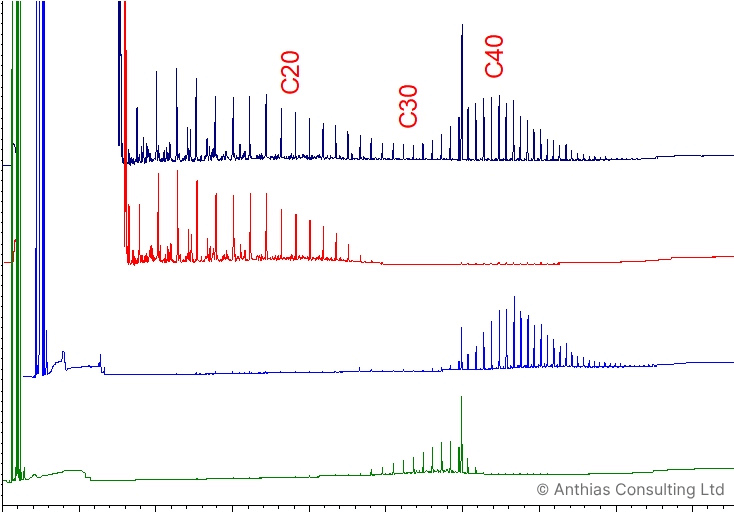
The picture in Figure 1 shows just how powerful the inlet temperature can be to transfer or exclude from the column compounds of interest or those not of interest.
- At the top is the full sample, an alkane wax, in navy blue.
- Second from top, in red, is the same sample excluding the higher molecular weight compounds, with 100% transfer up to and including C20.
- Third down, in bright blue, is flushing everything up to C40, with 100% transfer to the column of C40 and higher.
- At the bottom, in green, is only 100% transfer to the column of C30, with as much flushed out of the split exit before and after C30 as possible.
Of course, because a split is used to flush, a small amount still transfers to the column of those unwanted compounds, due to the split ration. This is just by changing the inlet temperature and when the split flow is turned on or off using a programmable temperature vapourising (PTV) inlet!
To learn more about sample introduction techniques attend
- Practical Essentials of GC sample introduction which is module 3 of our Complete GC and GC-MS
- Hands-on GC and GC-MS | Anthias Consulting which is day one of our Hands-on GC and GC-MS
- Practical Essentials of GC and GC-MS advanced injection
- Comprehensive GC hardware (Agilent GC)
- Comprehensive GC hardware (Shimadzu GC)
- Comprehensive GC hardware (Thermo GC)
- Comprehensive GC hardware (Scion/Bruker/Varian GC)
to learn more about selective discrimination as shown in the figure attend
Don’t forget that you can also subscribe to our newsletters and receive useful tips straight to your inbox!


