
Published: 5th February 2014 | © Anthias Consulting Ltd
In the Sample Introduction section of our Complete GC & GC-MS course we highlight the importance of selecting the correct liner for the injection type that you are going to perform. Some of the questions to ask are:
- Is it a solvent, gas or a solventless injection that you are performing and what vapour volume will it produce if any? This will affect the volume of the liner (internal diameter).
- Are you trying to get all the sample onto the column or are you going to flush most out of the split exit? This will affect the style of the liner (tapers, etc.).
- Are you trying to efficiently mix the sample with the carrier gas, wipe the end of the needle for viscous samples or trying to trap dirt? This will affect the position of any wool present.
- Are your analytes active and low concentration? This will affect the degree of deactivation and if to use glass wool at all!
Selecting the wrong liner for the sample introduction technique can have disastrous consequences including poor sensitivity, poor reproducibility, lost peaks, contamination of the inlet and gas lines, carryover, ghost peaks, poor peak shapes, the list continues…
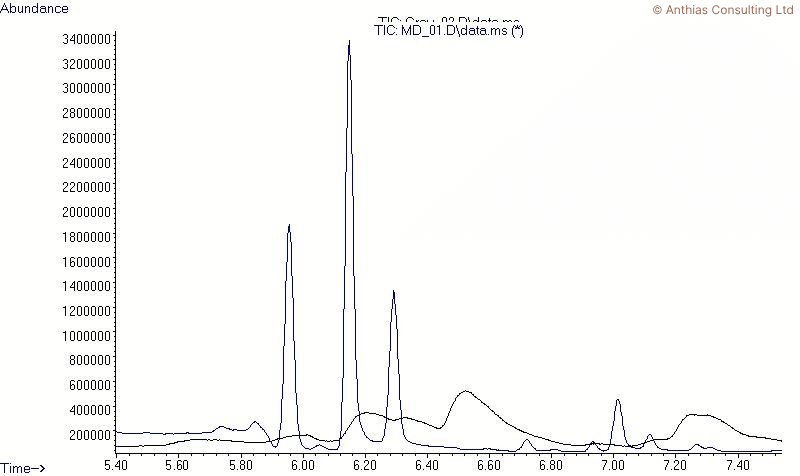
One example is trying to use a large internal diameter (ID) liner (e.g. 4 mm) for a solventless Solid-Phase Micro-Extraction (SPME) injection in splitless mode. SPME injection is solventless, the objective is to desorb the fibre in the inlet and quickly transfer the analytes onto the analytical column in a narrow sample band to get sharp peaks. Long desorption or transfer times allow the volatile analyte molecules to migrate down the analytical column and produce broad peaks, which have a much lower sensitivity (signal to noise ratio) as well as poor resolution. A large ID liner has a large volume which takes longer to flush, resulting in the broad peaks as shown in Figure 1 in black. Using the recommended, much narrower 0.75 mm ID SPME liner helps both the desorption but mainly the transfer of analytes onto the column, as it takes much less time to perform a complete flush of the liner, giving sharp Gaussian peaks, with a vastly improved S/N and baseline resolution as shown in Figure 1 in blue. In this example, worse still would be to use the wrong liner containing wool near the top or middle, because the fibre is very likely to break when exposed for desorption within the inlet.
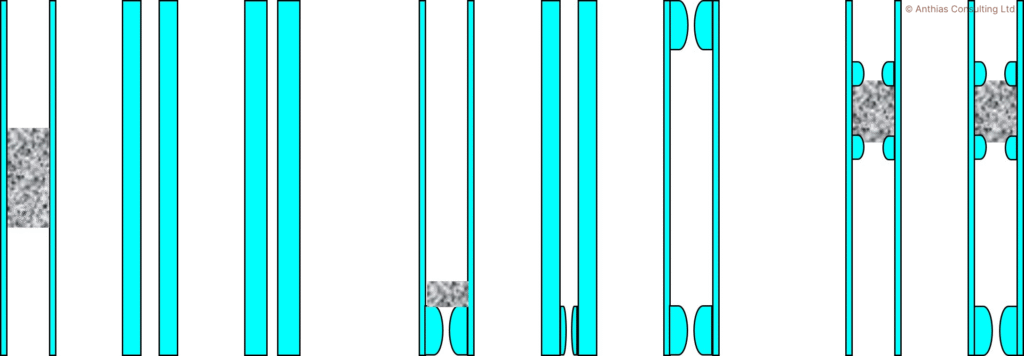
There are many liners on the market, if in doubt about the type of liner to use (Figure 2), ask yourself the above questions which are the main points to think about and attend our GC training courses to learn and understand more.
To learn more about inlet liner selection, attend:
- Practical Essentials of GC introduction, gases and plumbing and sample introduction, day one and Practical Essentials of GC sample introduction, module four of our Complete GC and GC-MS
- Hands-on GC theory and methods , day one of our Hands-on GC and GC-MS
- Comprehensive GC hardware (Agilent GC)
- Comprehensive GC hardware (Shimadzu GC)
- Comprehensive GC hardware (Thermo GC)
- Comprehensive GC hardware (Scion/Bruker/Varian GC)
- Hands-on GC and GC-MS advanced injection
- Practical Essentials of GC and GC-MS advanced injection
Don’t forget that you can also subscribe to our newsletters and receive useful tips straight to your inbox!


