
Published: 14th November 2016 | © Anthias Consulting Ltd
Method miniaturisation is the squeezing of as many instrumental and analytical parameters as possible to optimise efficiency. Variables that can be examined include extraction solvent, extraction technique, injection onto the column, separation on column, quantitation via the detector and finally the cycle time of one analytical run. As we strive to make the method more robust, we should improve quality, obtain an equivalent if not better Limit of Detection (LOD) and deliver the result more quickly and hence more cheaply.
Quantification via the detector
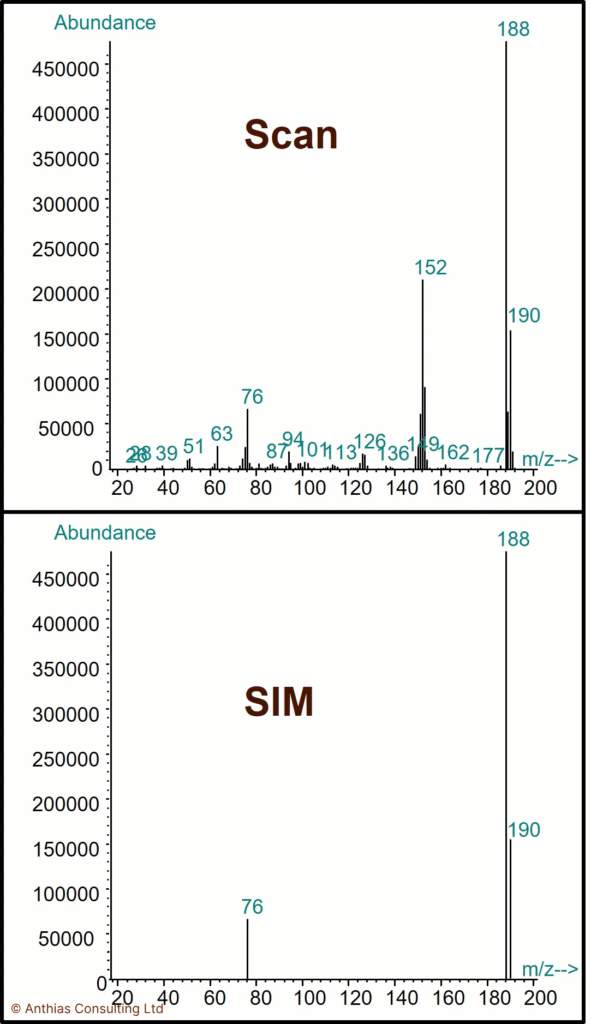
Modern GC is blessed with a diverse availability of specific detectors (at least sixteen) that respond to a plethora of analytes, atoms, bonds, chemical or physical characteristics. Specific detectors such as a micro-Electron Capture Detector (µECD) can bring 4 orders of magnitude greater sensitivity than say a Flame Ionisation Detector (FID); a Nitrogen Phosphorus Detector (NPD) has an impressive 105 linear range; Pulsed Flame Photometric Detector (PFPD) like the µECD can detect fg amounts on column but none of these detectors may be viable with large analytical suites where functional groups can be present or absent and identification of unknowns may be very important. Gas Chromatography Mass Spectrometry (GC-MS) may consequently be required and in moving from Scan* analysis to SIM** (Figure 1) with a single quadrupole mass analyser (SQMS), the higher sensitivity may enable the scaling down of front end extraction volumes.
*Scan analysis within GC-MS spends the finite time available scanning every signal across a specified mass range, usually to 1 decimal place, consequently enabling the identification of unknowns from library matching.
**In comparison SIM analysis enables the detection of 1-12 different ions only, within any given time window, giving more data points per peak, as more cycles per second and longer dwell times on each ion are enabled.
Modern instrumentation allows synchronous SIM/SCAN enabling simultaneous qualitative analysis of unknowns with accurate quantitation of targets.
More recent developments have seen the GC-QQQMS (triple quadrupole mass spectrometer) become very popular, especially for the target analysis of low concentration analytes in complex matrices. Although the sensitivity and the specificity are much higher (due to reducing the background using tandem mass spectrometry (MS/MS)), and simultaneous Multiple Reaction Monitoring (MRM)/Scan can be achieved with many manufacturers, similar to synchronous SIM/Scan with a SQMS, performing Scan mode with a QQQMS results in lower quality mass spectra for the identification of unknowns.
Therefore, even due to more recent developments in technology, which is the best instrument boils down to is sensitivity more important or the correct identification of unknown compounds? Unless of course you have the budget to purchase a Time-of-Flight (ToF) mass analyser where no compromise needs to be made.
First published in Chromatography Today Feb/Mar 2016 issue.
To learn more about GC detectors attend
- Practical Essentials of GC columns, detector and mass spectrometers
- Hands-on GC theory and methods – GC dectectors
- Hands-on GC-MS theory and methods – mass spectrometers for GC
- Comprehensive GC hardware (Agilent GC)
- Comprehensive GC hardware (Shimadzu GC)
- Comprehensive GC hardware (Thermo GC)
- Comprehensive GC hardware (Scion/Bruker/Varian GC)
Don’t forget that you can also subscribe to our newsletters and receive useful tips straight to your inbox!


