
Published: 5th December 2016 | © Anthias Consulting Ltd
Method miniaturisation is the squeezing of as many instrumental and analytical parameters as possible to optimise efficiency. Variables that can be examined include extraction solvent, extraction technique, injection onto the column, separation on column, quantitation via the detector and finally the cycle time of one analytical run. As we strive to make the method more robust, we should improve quality, obtain an equivalent if not better Limit of Detection (LOD) and deliver the result more quickly and hence more cheaply.
Cycle time of one analytical run – how can it be shortened
There is always a lot of focus on making run/acquisition times shorter however, this is only part of the total GC cycle time before another sample can be analysed. The remainder of the cycle time is the time it takes for the GC to come ready for the next analysis and usually the longest time delay is the oven cooling down.
As the typical GC oven heating process is very inefficient (fundamentally it is heating up air in an oven), improvements have been steadily introduced over history some of which are futuristic, encapsulating the capillary column in a heated metal shield that directly heats the column or the direct ballistic heating of planar columns, both have very little air around the column to heat resulting in the ability to heat the columns rapidly, up to 250°C/min. Another approach is to reduce the oven sizes thereby reducing the air volume that is required to be heated and cooled, including the use of thermally stable oven pillows.
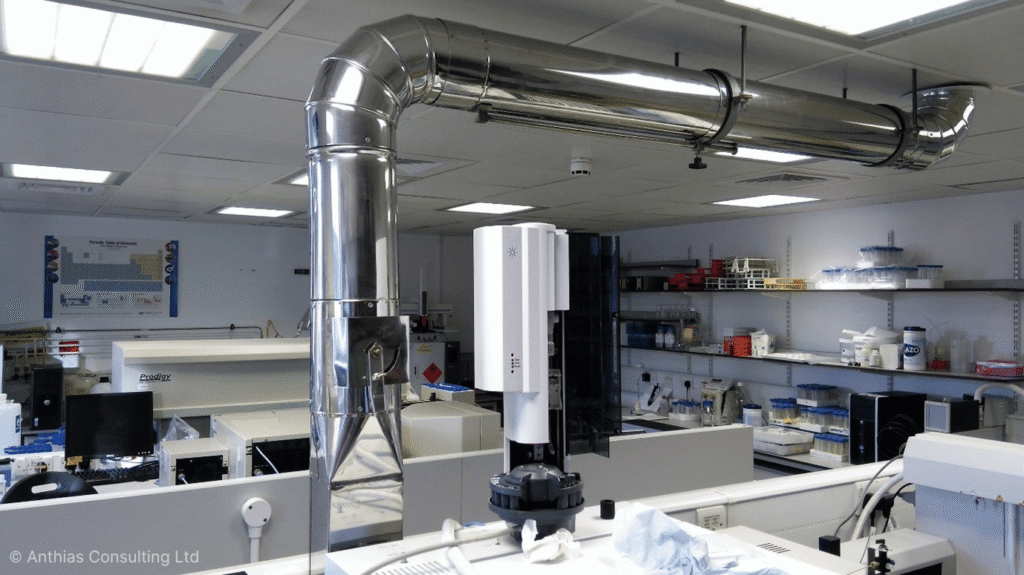
To reduce oven cooling time, an option is the use of high efficiency secondary cooling fans blowing cold air through the GC oven flap at the end of the cycle. Cryogenic gases can be used to cool ovens even more quickly but are an expensive solution and demand health and safety awareness. Some broad-minded laboratories have vented the heat from the GCs through chimneys that feed into ductwork and exhausted from the building courtesy of a robust fan (Figure 1). All GC analysts are extremely thankful in the summer for the latter technology but strangely less so in the winter. It must also be noted that modern GC kit invariably brings efficiencies of which a quicker cooldown rate is foremost. One of the key points in the laboratory to help reduce cool down times is to never install a GC against the wall, as a lot of the heat being blown out bounces back off the wall. Care should be taken of where the heat is going to go too, for example plastic trunking, a PC or even an analyst should not be located directly behind the oven flaps. GCs should be installed on desk-type benches located 0.5-1 meter from the wall, also making maintenance and troubleshooting at the back of the instrument easier too.
Generally, detectors need very little time to be ready after an analysis has finished. Certain types of inlets are heated, for example cold-on-column (COC), programmable temperature vaporisers (PTVs) and multi-mode inlets (MMI) and when purchasing careful consideration should be given to what form of inlet cooling should be used and this depends on the minimum temperature to be obtained and the relative initial oven temperature. Inlet cooling can be performed by air, liquid CO2, liquid nitrogen or a Peltier cooler. If the inlet cooling is your bottle neck, consider upgrading to a different coolant.
All of the above solutions have one thing in common, they shorten cycle times and therefore save money by improving delivery, even saving 1 minute per run saves 1 hour in a batch of 60 analyses!
First published in Chromatography Today Feb/Mar 2016 issue.
To learn more about GC ovens and GC sample introduction techniques attend:
- Practical Essentials of GC columns, detector and mass spectrometers – for GC ovens
- Practical Essentials of GC introduction, gases and plumbing and sample introduction – for GC sample introduction techniques
- Hands-on GC theory and methods
- Comprehensive GC hardware (Agilent GC)
- Comprehensive GC hardware (Shimadzu GC)
- Comprehensive GC hardware (Thermo GC)
- Comprehensive GC hardware (Scion/Bruker/Varian GC)
To learn Programmable temperature vaporisers (PTVs) attend:
- Hands-on Multi-mode inlets and Programmable temperature vaporisers
- Practical Essentials of Multi-mode inlets and Programmable temperature vaporisers
Don’t forget that you can also subscribe to our newsletters and receive useful tips straight to your inbox!


