
Published: 18th August 2026 | © Anthias Consulting Ltd
In GC-MS, imagine if you suddenly didn’t have access to the plethora of excellent Mass Spectral libraries. Or, your compound wasn’t included in any library – they are not exhaustive! Or, as so often happens, lots of matches are shown that have a similar quality, how do you know which one?
After the initial shock has subsided, thought processes should quickly lead to the fundamentals of interpretation…
You’ll be pleased to know there are many excellent tools available within this huge but fun area:
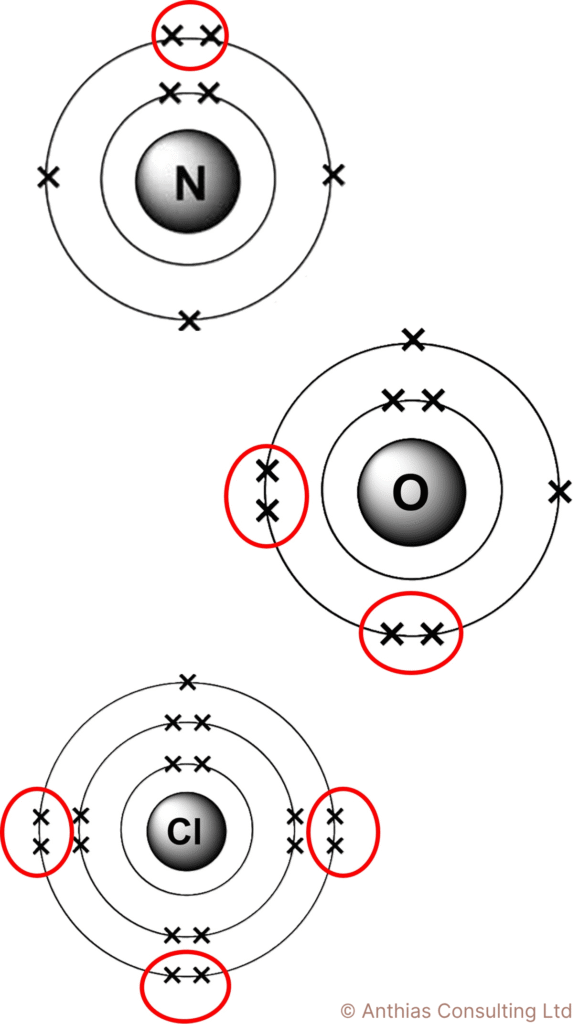
Basic Inorganic and Organic Chemistry along with the electronic configuration of atoms (Figure 1) are a big help and a great place to start !
A quick lesson in relative strength or weakness of an organic structure can lead to Rapid Mass Spectral Evaluation, together with Isotopes which give key clues from their ion spacings / ratiosand Isomers which have great use in demonstrating how jigsaw pieces can only fit in a certain way !
Saturated, Branched and Aromatic Hydrocarbons due to their bond strengths within a molecular structure can greatly affect how a mass spectrum looks.
Heteroatoms are atoms that have replaced carbon in the backbone of a molecule, are the foundation of functional groups and can be sites of great chemical activity, thereby explaining fragmentations.
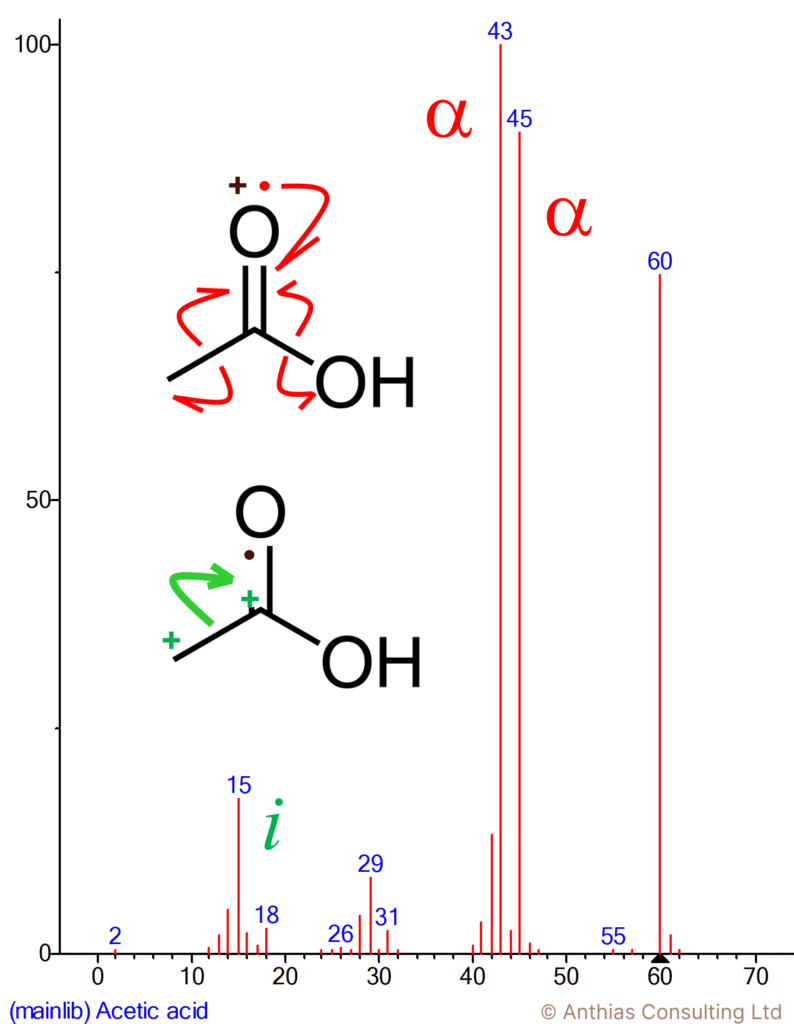
Cleavage mechanisms are of two main types and depend on the make-up of the molecule, fragmentation takes place at ionisation sites, with some parts of the molecule a very likely site and others less so but still possible (Figure 2).
Isotopic Abundances and Ratios are very useful for mass accounting and tables exist for ease of use.
Rings and Double Bonds help postulate a variety of structures, some may fit, some may not but for certain one will be a perfect fit.
The nitrogen rule indicates almost without exception (!) how many nitrogen atoms are present in the molecular ion.
Logical and Illogical losses help explain the mass losses we see in the mass spectrum, tables of data exist to help us, remember a mass spectrum can have hundreds of ions, therefore by definition there will be overlaps of many fragmentation processes, if I was to tell you the homologous series of saturated alkane losses is not 14 mass units at a time, what would you postulate you are actually seeing ?!
Normalisation is also critical in mass accounting, remember behind every centroid mass spectrum there is a profile mass spectrum, the y axis in a mass spectrum is either absolute abundance or relative abundance, decent software should allow easy switching between both. Be certain that relative abundances are normalised to 100%, misidentifications may result otherwise.
Nitrogen and Oxygen are ubiquitous, indicative and undergo classes of reactions in their own rights dependent on the molecular structures they are part of.
Esters and Ethers can obviously be symmetrical or non-symmetrical and whilst often exhibiting both types of cleavage, they may lean towards one.
A+2 Isotopes can be some of the final keys to unlocking a structure, they are even more useful if they co-exist with an A+1 isotope for the same element whereupon certain heteroatoms can then be identified or eliminated.
Sulphur has a class of reactions to itself and is of course another prevalent heteroatom.
Finally we move into realms that are very hard to predict for instance sequential cleavages (ones that depend on others) and of further complexity, ring openings / closings and molecular re-arrangements.
If all that sounds interesting, imagine how much more interesting it would be if you didn’t have that GC-MS library !
To learn more and put into practice what you learn attend:
- Applied Interpretation of GC-MS spectra
- Applied Interpretation of LC-MS spectra
- Applied Interpretation of FTIR spectra
Note: if you are interested in both GC-MS and LC-MS spectral interpretation, we recommend attending Applied Interpretation of GC-MS spectra first.
Don’t forget that you can also subscribe to our newsletters and receive useful tips straight to your inbox!


