
Published: 18th August 2026 | © Anthias Consulting Ltd
In liquid chromatography (LC), the diode array detector (DAD) is often overlooked as a technique for unknowns analysis, with a preference for using mass spectrometers hyphenated to chromatography instrumentation, however, LC-DAD has many advantages in terms of cost and simplicity of instrumentation making it a good choice for many applications.
In LC – DAD the ability to collect UV-Vis ‘scan’ data enables peak purity estimations, this combined with a retention time identifier gives an overall 3-dimensional output akin to GC-MS. Thousands of compounds are present in many libraries, covering applications from environmental, through pharma, cosmetics, pesticides and QC testing, many of these compounds aren’t amenable to GC analysis.
 |
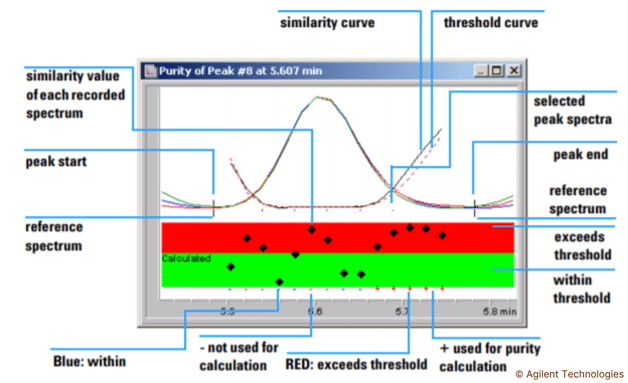 |
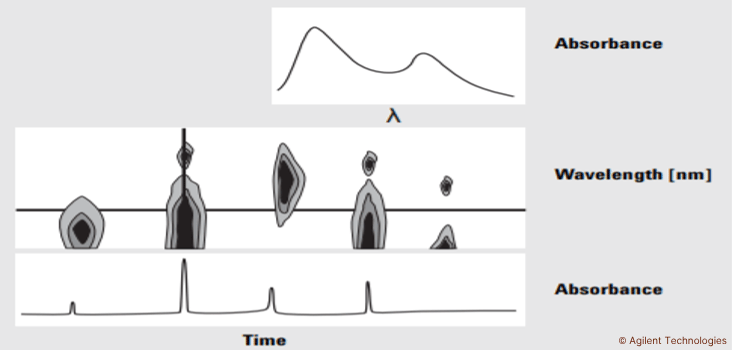
The theory is based on an absorbance profile over a wavelength range, as shown in Figure 1. Plus, many other parts of a matching algorithm combine to give a ‘peak purity’, as shown in Figure 2, leading to powerful probability-based matching (PBM).
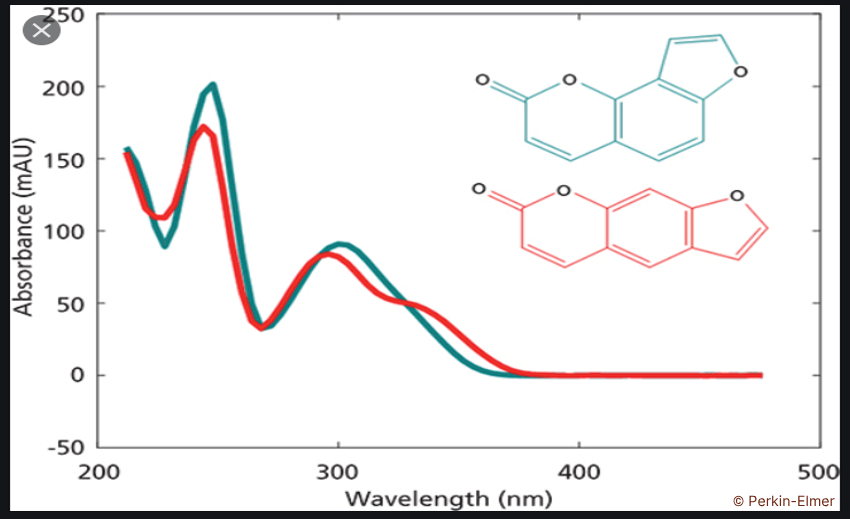
Small differences in the spectra can also differentiate between isomers, as shown in Figure 3, which mass spectrometers aren’t so good at.
To learn more about LC-DAD attend
- Practical Essentials of LC and LC-MS columns, detectors and data analysis
- Hands-on HPLC theory and methods
Don’t forget that you can also subscribe to our newsletters and receive useful tips straight to your inbox!


