
Published: 25th March 2011 | © Anthias Consulting Ltd
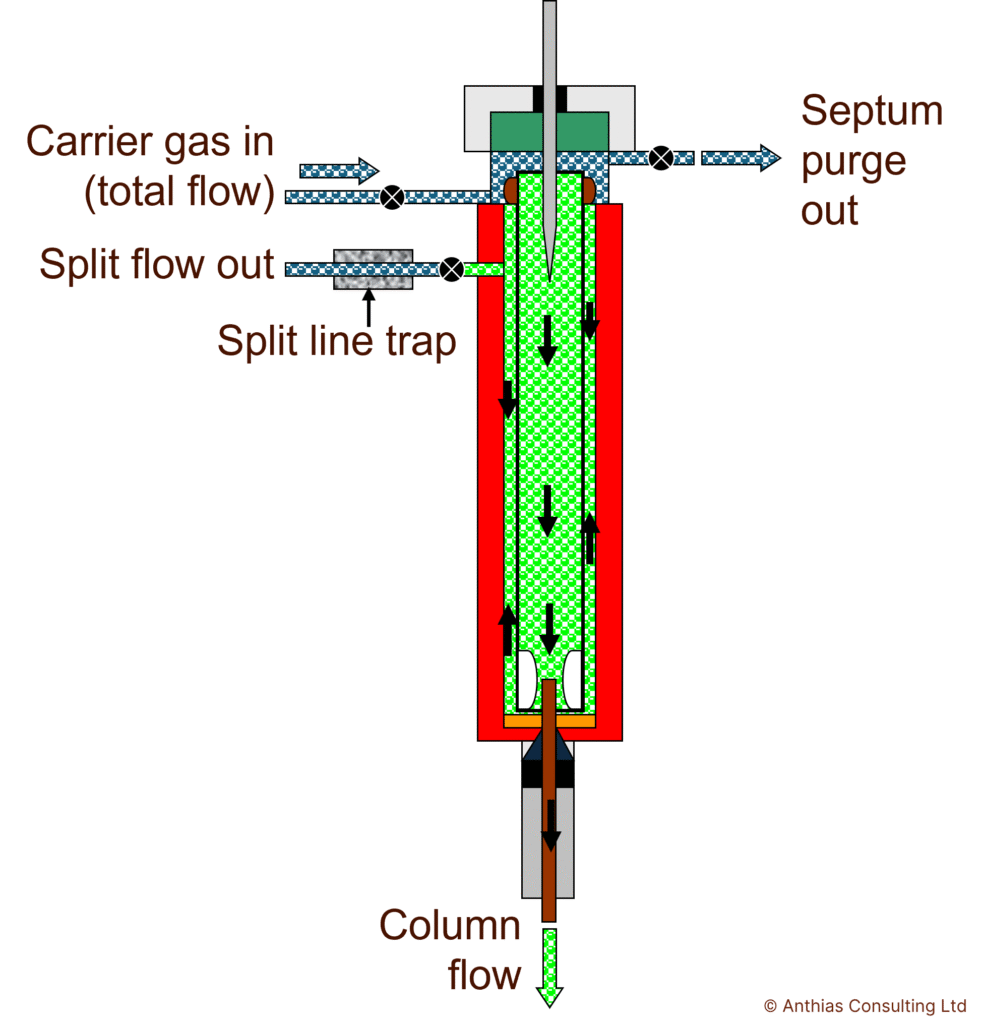
Splitless injections are used to transfer all of the injected analytes onto the analytical column for separation and detection and are therefore used for low concentration samples. Opening the split exit too early causes any remaining analytes in the inlet to be flushed out of the split exit and lost. Opening it too late (or not at all) leads to a long, tailing solvent peak which can interfere with the separation and detection of early eluting peaks and provides a higher baseline well into the chromatogram. Opening the split exit at the correct time firstly allows the target analytes to be transferred under splitless conditions and then flushes any remaining solvent trapped around the outside of the liner, preventing it from gradually bleeding onto the column (Figure 1).
How do you determine the split open time?
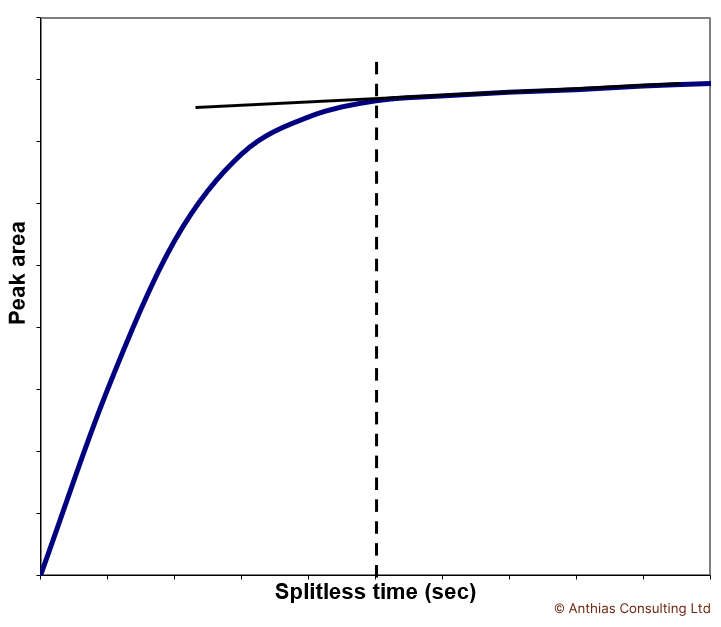
- Experimentally, the split open time can be increased (or decreased) stepwise and the analyte responses monitored, a plot of split open time vs. response can be used to determine the point where the response plateaus and then the time is chosen (Figure 2), although this should not be on the ‘cliff edge’ for a robust method.
- A rule of thumb is two flushes of the inlet liner volume and this can be quickly calculated as long as the liner volume and column flow (when injecting) are known. Transfer will not take longer than this unless you have activity or a longer sample flow path through the liner, for example when using a packed liner but, it could take less time so calculate splitless time as a starting point and then optimise experimentally, as above.
To learn more about splitless injections, attend:
- Practical Essentials of GC introduction, gases and plumbing and sample introduction, day one of our Complete GC and GC-MS
- Practical Essentials of GC sample introduction, module three of our Complete GC and GC-MS
- Hands-on GC theory and methods, day one of our Hands-on GC and GC-MS
- Practical Essentials of GC and GC-MS advanced injection
- Hands-on GC and GC-MS advanced injection
- Comprehensive GC hardware (Agilent GC)
- Comprehensive GC hardware (Shimadzu GC)
- Comprehensive GC hardware (Thermo GC)
- Comprehensive GC hardware (Scion/Bruker/Varian GC)
Don’t forget that you can also subscribe to our newsletters and receive useful tips straight to your inbox!


