
Practical Essentials of LC and LC-MS data analysis

- Duration: 2 hours for on-demand
- Experience level: Intermediate
- Delivery methods: Offsite training & consultancy | On-Demand | Online | Onsite training & consultancy | Tailored training |
- Type of course: Universal
- Applicable to manufacturer(s): Agilent | Bruker | CTC analytics | JASCO | PerkinElmer | Sciex | Scion | Shimadzu | Thermo | Waters |
- CPD Approved: Approved
- Scheduled course price: £130.00 + TAX per delegate
- Course discounts: RSC CAMS HEaTED Cambridge Network members receive a discount on this course
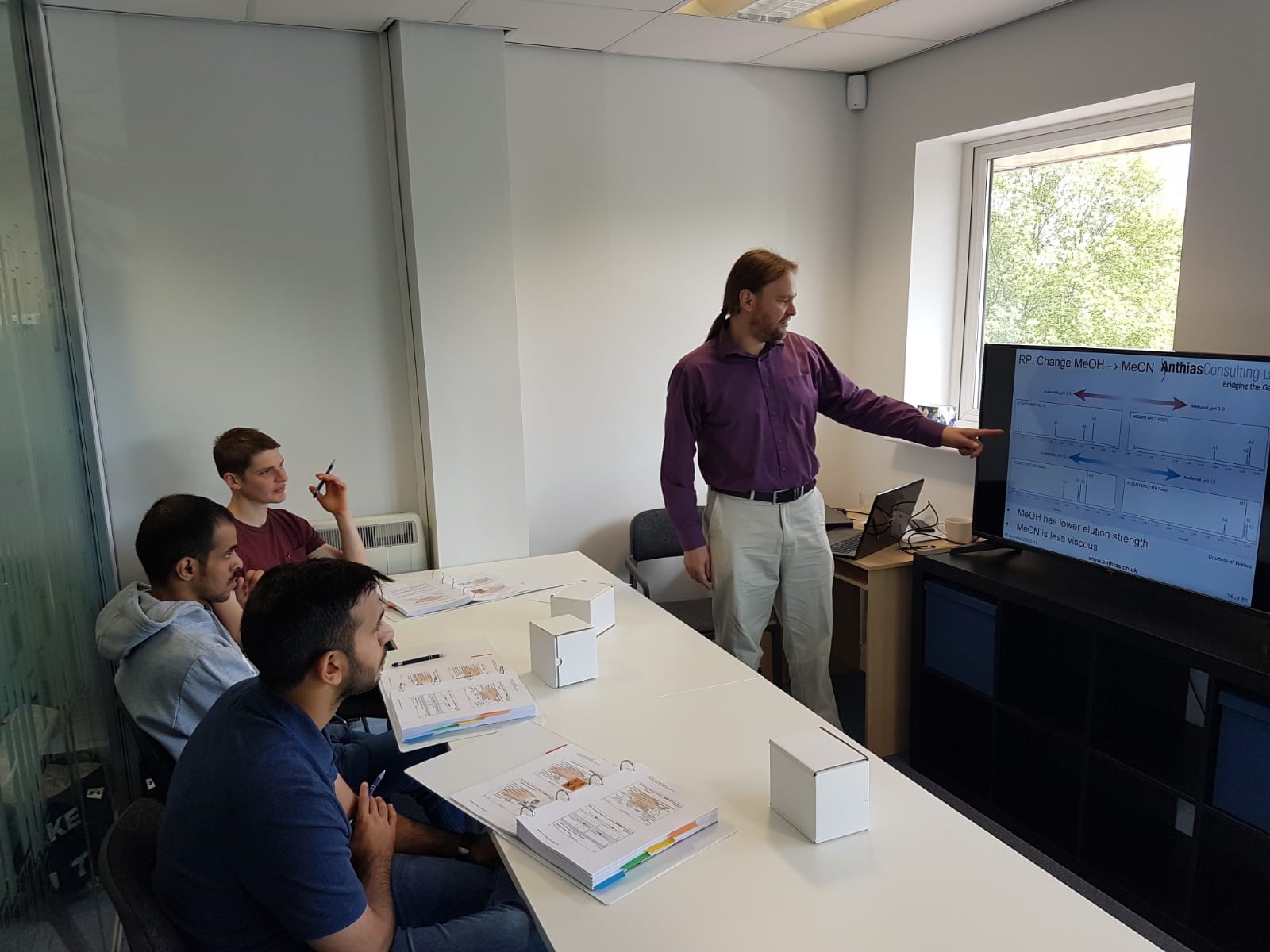
Your essential guide to data analysis for liquid chromatography (LC) and liquid chromatography-mass spectrometry (LC-MS)
Module 6 of the Complete LC & LC-MS and the Practical Essentials of LC & LC-MS course.
Practical Essentials of LC and LC-MS data analysis is approved by the Royal Society of Chemistry (RSC) for the purposes of Continuing Professional Development (CPD). Take an in-depth approach to chromatographic data analysis, covering the principles of data processing, peak integration, qualitative identification and quantitative analysis used in modern LC and LC-MS laboratories. This training is designed for professionals, students and scientists who want to enhance ther knowledge in interpreting LC and LC-MS data.
This module can be combined with any of the other twelve modules in the Complete LC & LC-MS to tailor your training needs.
Why should I join?
On completion of this Module 6 training, you will have a solid understanding of LC and LC-MS data analysis, giving you:
- An overview of data processing and chromatographic integration principles
- Clear explanations of qualitative and quantitative data analysis approaches
- Understanding of how integration settings influence analytical results
- An overview of calibration methods used for quantitative analysis
- A great addition to the other modules in our Complete LC & LC-MS programme
- A valuable refresher on data analysis if you have not worked with LC or LC-MS data for a while
What would I learn?
This module focuses on explaining how chromatographic data is processed and interpreted, where you will learn:
- The fundamentals of chromatographic data acquisition and processing
- How integration algorithms identify and quantify chromatographic peaks
- How to optimise integration parameters for reliable results
- Approaches for analysing co-eluting and overlapping peaks
- The fundamentals of qualitative analysis using retention times and spectral data
- The principles of quantitative analysis using calibration standards
- The differences between external standards, internal standards, standard addition and semi-quantitative approaches
What knowledge will I gain?
By the end of the module, you will:
- Understand how chromatographic software processes and integrates analytical data
- Know how baseline placement, peak detection settings and integration parameters influence reported results
- Understand the importance of signal-to-noise ratio and data acquisition rates for accurate quantitation
- Be able to recognise common challenges associated with co-eluting peaks and complex chromatograms
- Comprehend how qualitative analysis can be used to identify or confirm the presence of target compounds
- Know how calibration curves are prepared, assessed and applied for quantitative analysis
- Understand the principles of area percent, external standard, internal standard and standard addition methodologies
- Appreciate the benefits of stable isotope-labelled internal standards for improving analytical precision
Is this course for me?
This course is designed for anyone who would like to learn about LC and LC-MS data analysis.
- Laboratory analysts and technicians responsible for processing chromatographic data
- Laboratory or line managers overseeing LC and LC-MS analytical workflows
- Data analysts and report writers working with LC and LC-MS results
- Service engineers seeking a chemistry-focused understanding of analytical data processing
- Sales, commercial or marketing teams who work with LC and LC-MS instruments, software or services and would like more in-depth knowledge
If LC or LC-MS touches your work in any way, this well-planned course, delivered by experts in the field, equips you to understand the science behind these techniques.
Select the courses you are interested in:
Feedback from previous attendees
“I found the part about coeluting peaks very helpful as this is often a problem for me – seeing the different options for integrating these peaks was very handy. More information on quality monitoring in this module was also great to have.” Joe Richardson, Assistant Scientist, Environment Agency (November 2020).
“[I enjoyed the] level of detail information presented.”
“Useful discussion. Better material and knowledge of the instructor is helpful.”
“Professional, high quality delivery, keep track on time.”
“The instructor is aware of all the LC-MS spectrometry. I found in this course useful materials.”
“[I enjoyed] developing an understanding of the applications and function of the equipment.”
“The HPLC & LC-MS training was good and I enjoyed it because I have learnt a lot.”


