
Practical Essentials of LC and LC-MS mass spectrometers and sample preparation
- Duration: 1 day for live courses
- Experience level: Intermediate
- Delivery methods: Face-to-face | Offsite training & consultancy | On-Demand | Online | Onsite training & consultancy | Tailored training |
- Type of course: Universal
- Applicable to manufacturer(s): Agilent | Bruker | CTC analytics | JASCO | PerkinElmer | Pyrolab | Sciex | Scion | Shimadzu | Thermo | Waters |
- CPD Approved: Not yet approved
- Scheduled course price: £425.00 + TAX per delegate
- Course discounts: RSC CAMS HEaTED Cambridge Network members receive a discount on this course
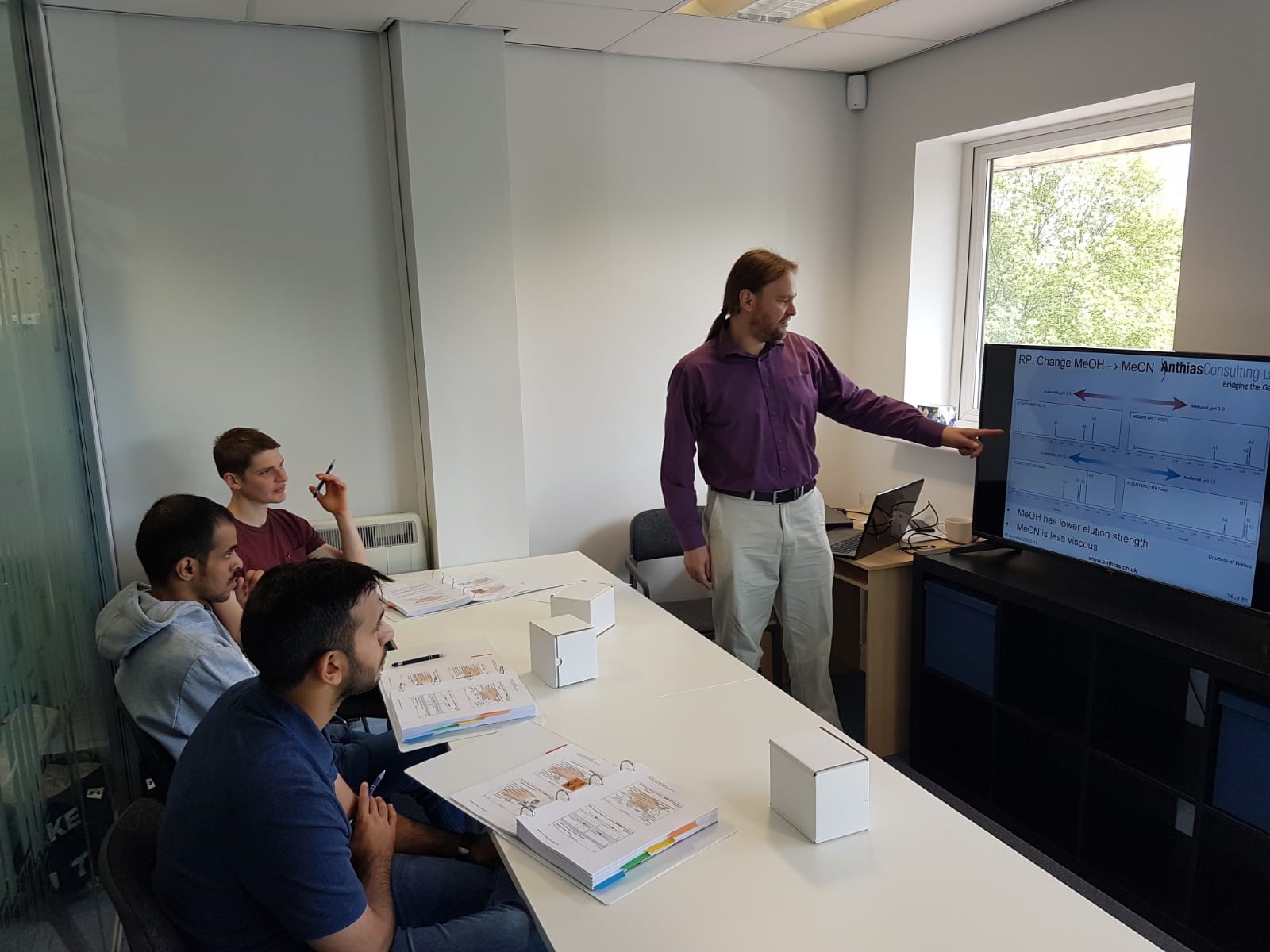
Your essential guide to liquid chromatography (LC) and liquid chromatography-mass spectrometry (LC-MS) mass spectrometers and sample preparation
Day 3 and Modules 7 and 8 of the Complete LC and LC-MS and the Practical Essentials of LC and LC-MS course.
Practical Essentials of LC and LC-MS mass spectrometers and sample preparation is approved by the Royal Society of Chemistry (RSC) for the purposes of Continuing Professional Development (CPD), and is a classroom-based course that takes an in-depth approach to the principles, applications and operation of mass spectrometers used in modern LC as well as sample preparation techniques used for LC and LC-MS analysis. Designed for professionals, students and chemists wanting to take a further step to enhancing their LC and LC-MS knowledge.
This day and modules can be combined with any of the other twelve modules and days in the Complete LC and LC-MS to tailor your training needs.
Why should I join?
On completion of day 3 training, you will gain understanding of mass spectrometers, alongside sample preparation techniques and strategies used in LC and LC-MS analysis, giving you:
- An overview of the key components of an LC-MS system
- Clear explanations of mass spectrometric principles and terminology
- Understanding of how molecules are ionised, separated and detected
- An overview of the most widely used sample preparation techniques for LC and LC-MS
- Clear explanations of sample clean-up, extraction and concentration strategies
- Understanding of how sample preparation affects analytical accuracy and precision
- An excellent addition to other modules and days in our Complete LC and LC-MS training
- A great refresher if you have not worked with LC or LC-MS for a while
What would I learn?
This day focuses on mass spectrometers and sample preparation methods used in LC and LC-MS, where you will learn:
- How liquid chromatography is coupled to mass spectrometry
- The role of vacuum systems in modern mass spectrometers
- The principles of electrospray ionisation (ESI), atmospheric pressure chemical ionisation (APCI) and atmospheric pressure photoionisation (APPI)
- The fundamentals of mass spectra, mass-to-charge ratios (m/z) and isotopic patterns
- Why sample preparation is critical to successful chromatographic analysis
- How filtration, ultrafiltration and desalting techniques protect instruments and improve performance
- How solid phase extraction (SPE) can be used for clean-up, concentration and solvent exchange
- The principles of liquid-liquid extraction (LLE) and extraction solvent selection
What knowledge will I gain?
By the end of the day, you will:
- Understand how mass spectrometers generate and interpret mass spectral data
- Know the advantages and limitations of the major ionisation techniques used in LC-MS
- Be familiar with common ion types, adducts and isotope patterns encountered in LC-MS
- Know how vacuum systems and ion optics contribute to instrument performance
- Understand how sample preparation affects chromatographic performance, detector response and data quality
- Know the benefits and limitations of common sample preparation techniques used in LC and LC-MS
- Be familiar with recovery calculations and the importance of analyte recovery during method validation
- Understand the role of derivatisation in improving analyte detectability, stability and chromatographic behaviour
Is this course for me?
This day is designed for anyone who would like to learn about mass spectrometers and sample preparation for analysis in LC and LC-MS:
- Laboratory analysts & technicians using LC and LC-MS
- Laboratory or line managers overseeing LC and LC-MS instruments and analysis
- Data analysts and report writers who work with LC and LC-MS data
- Service engineers who want a chemistry focused introduction
- Sales, commercial or marketing teams who work with LC and LC-MS components, instruments, services or personnel in any way and would like more knowledge
If LC and LC-MS touches your work in any way, this well-planned module, delivered by experts in the field, equips you to understand the science behind these analytical chemistry techniques.


