
The aims of sample introduction into the column, for any chromatographic technique, is to transfer the sample (or a portion of it) that is representative, repeatable, reproducible, to not introduce any chemical change and to introduce the analyte molecules in a tight sample band to obtain sharp peaks.

GC sample introduction is involved, requiring much thought and optimisation. GC inlets (Figure 1) have three jobs: to enable the introduction of the sample with no loss or contamination while keeping flows stable, vaporisation of the components of interest and then their transfer to the column, while keeping higher molecular weight matrix within the liner.
Injections into the GC inlet may be manual (less precise) or automated, both require optimisation to achieve the final goal of that tight representative sample band with no artefacts.
The inlet is pressurised for use and while it has a large number of potential leak points, a good routine maintenance protocol will eliminate all of them.
Inside the inlet there should be a liner suitable for the injection technique whether it be hot split, hot splitless or even something more advanced and the analytes, deactivation is very important for many classes of compounds. Liner choice, including capacity and any packing material, is critically important when it comes to good chromatography, as are the timings for each part of the injection cycle, from flash volatilisation to final transfer and focussing. Keeping the inlet clean between injections requires septum purge and split flows and correct empirically derived time intervals.
Advanced inlets allow hot and cold injections, greatly extending the scope of analyses to e.g. large volume injection (LVI) and the analysis of compounds compromised by mass discrimination or thermal lability. At the extreme end of the transfer process, cold trapping and the solvent effect, when harnessed, can also greatly improve early peak shape.
LC sample introduction whilst simpler than GC still requires discipline to achieve a tight sample band avoiding peak broadening. The injection solvent is ideally the mobile phase, if not possible then it needs to be weaker than the mobile phase for ideal partitioning and better peak shape.
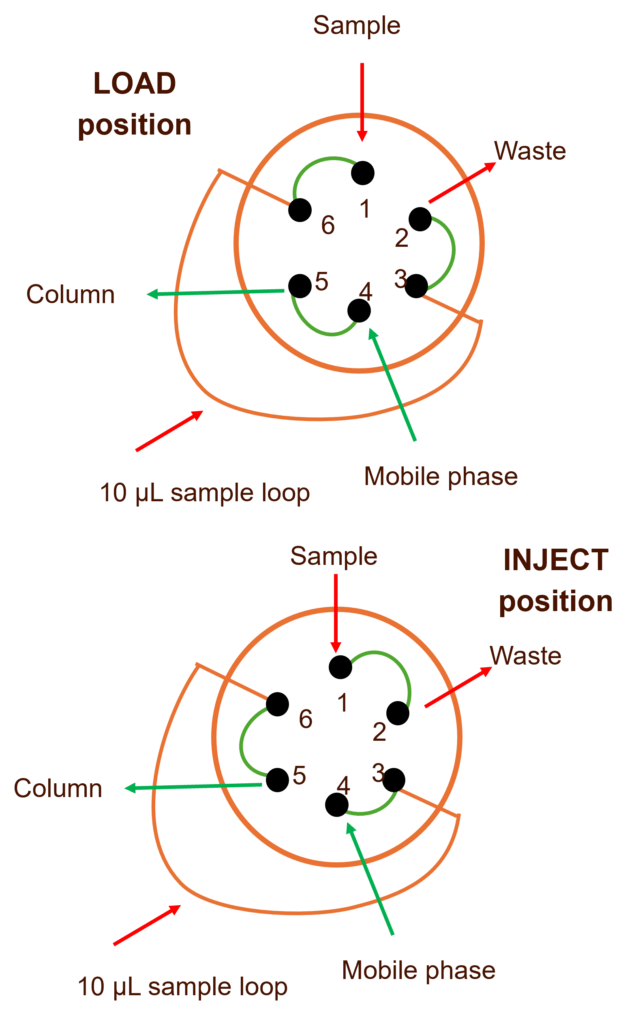
The main challenge with a liquid mobile phase is the large differential between the sample in the vial at atmospheric pressure being injected into ~5000 psi of column back pressure. A high pressure switching valve is required which can be operated manually or via an autosampler. The injector is usually a 6 port rheodyne valve, with choice of sample loop size determined by the column loading characteristics and the detector sensitivity (Figure 2). Autosampler injection is preferable to manual injection due to better precision, being able to run large sequences and reduced carryover due to automated wash cycles offering both weak and strong washes.
At the extreme end of this transfer process, injection modes can be either full loop which uses more sample but gives the best precision, partial loop with pressure assist which gives the fastest injection cycle, partial loop with needle overfill which gives the widest injection volume range or injection with flow through needle which gives the lowest carryover of all.
In conclusion, the challenges are different across GC and LC sample introduction but the core principles involved in building a robust method, as always, underpin everything including fully understanding and optimising the parameters involved.
To learn more about sample introduction techniques for GC & GC-MS, attend Day 1 / Module 3 of our Complete GC & GC-MS course.
To learn more about sample introduction techniques for HPLC & LC-MS, attend Day 1 / Module 3 of our Complete HPLC & LC-MS course.
Don’t forget that you can also subscribe to our newsletters and receive useful tips straight to your inbox!


