
Complete LC and LC-MS

- Duration: 5 days for live courses 32.50 hours for on-demand
- Experience level: Intermediate
- Delivery methods: Face-to-face | Offsite training & consultancy | On-Demand | Online | Onsite training & consultancy | Tailored training |
- Type of course: Universal
- Applicable to manufacturer(s): Agilent | Bruker | CTC analytics | JASCO | PerkinElmer | Sciex | Scion | Shimadzu | Thermo | Waters |
- CPD Approved: Approved
- Scheduled course price: £1,875.00 + TAX per delegate
- Course discounts: RSC CAMS HEaTED Cambridge Network members receive a discount on this course
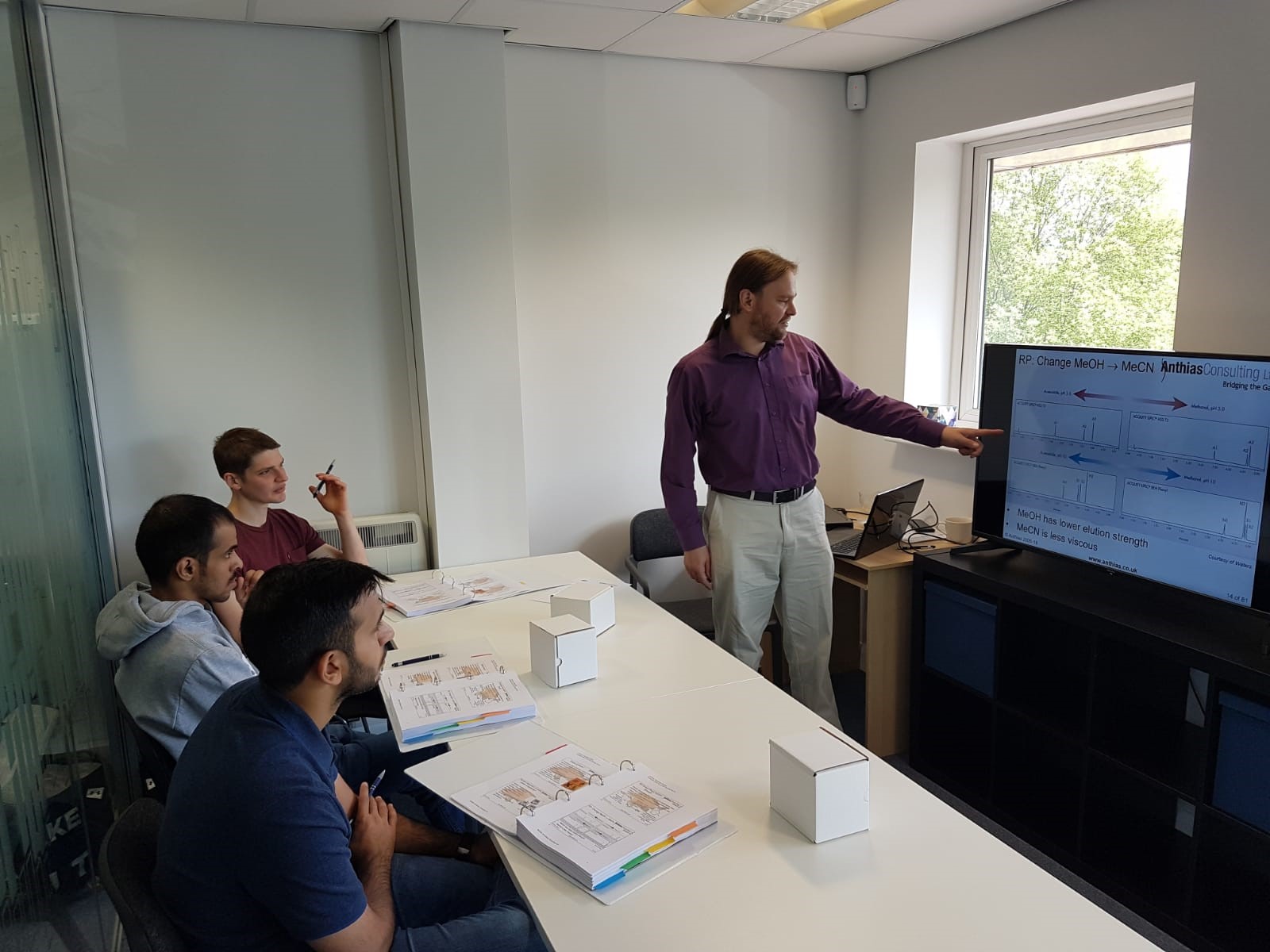
Your complete guide to Liquid Chromatography (LC) and Liquid Chromatography-Mass Spectrometry (LC-MS)
Learn everything you need to know about LC & LC-MS with this 5-day classroom-based training for chemists, students and professionals, is approved by the Royal Society of Chemistry (RSC) for Continuing Professional Development (CPD). Take an in-depth approach to LC and LC-MS combing the intermediate Practical Essentials of LC & LC-MS with the advanced LC and LC-MS Clinic, providing a complete course enabling you to understand your LC and LC-MS instrumentation. Covering chromatographic theory, instrumentation, sample preparation, mobile phases, pumps, sample introduction, column technologies, detectors, mass spectrometry, data analysis, method development, validation, maintenance, troubleshooting, and advanced analytical techniques.
Cover all the practical theory of how modern LC and LC-MS systems work from the chemistry and physical perspectives, how chromatographic methods are developed and optimised, and how reliable results are generated. Through practical examples, worked calculations, real-world applications, and case studies and with instrument parts to see and handle such as columns & consumables, develop the skills required to confidently develop, optimise, validate, maintain, and troubleshoot LC and LC-MS methods.
Why should I join?
On completion of this LC & LC-MS course, you will have a complete understanding of liquid chromatography, mass spectrometry, and the factors that influence analytical performance, reliability, and data quality.
- A clear understanding of chromatographic theory, retention mechanisms, selectivity, resolution, and efficiency
- An understanding of sample introduction systems, autosamplers, and injection strategies
- Insight into mobile phase selection, solvent properties, buffer chemistry, pH control, and gradient optimisation
- A thorough understanding of LC-MS instrumentation, ionisation techniques, mass analysers, tandem MS, and high-resolution mass spectrometry.
- Practical guidance on method development, optimisation, validation, maintenance, and troubleshooting
What would I learn?
This intermediate to advanced level course will provide all-round understanding, covering the practical theory of LC and LC-MS, you will learn the:
- The principles of chromatographic separation and analyte retention
- How sample properties influence sample preparation, recovery, matrix effects, and analytical performance
- Sample preparation approaches including, SPE, SPME, LLE, QuEChERS, protein precipitation, and derivatisation
- The operation and optimisation of pumps, autosamplers, injection systems, and solvent delivery modules
- Column selection and optimisation based on stationary phase chemistry, particle size, dimensions, and analyte properties
- The principles and applications of reversed-phase, normal-phase, HILIC, ion exchange, size exclusion, ion pairing, and chiral chromatography
- The operation, advantages, and limitations of common LC detector technologies
- Mass spectrometry fundamentals including ionisation, mass analysis, tandem MS, accurate mass measurement, and spectral interpretation
- Quantitative and qualitative analytical workflows, calibration strategies, and method validation principles
- Advanced chromatographic and LC-MS techniques including UHPLC, multidimensional LC, ion mobility, and high-resolution mass spectrometry
- Practical preventative maintenance strategies for LC and LC-MS instrumentation
- Systematic troubleshooting approaches for chromatographic, detector, vacuum, ion source, and data analysis problems
What knowledge will I gain?
By the end of the course, you will:
- Be able to confidently explain the principles of LC and LC-MS analysis
- Understand how sample preparation, chromatography, detection, and data analysis combine to produce reliable analytical results
- Know how solvents, buffers, gradients, temperature, flow rate, and column chemistry influence chromatographic performance
- Understand the advantages and limitations of different chromatographic modes, detector technologies, and mass analysers
- Recognise how sample characteristics influence method selection and analytical strategy
- Understand how ionisation techniques and mass spectrometers influence sensitivity, selectivity, and compound identification
- Learn how to interpret chromatographic and mass spectral data for qualitative and quantitative applications
- Become familiar with targeted and non-targeted analytical workflows, tandem MS methods, and high-resolution mass spectrometry
- Understand method validation requirements including calibration, accuracy, precision, linearity, robustness, detection limits, and quality control procedures
- Gain confidence in developing, optimising, validating, maintaining, and troubleshooting LC and LC-MS methods
- Understand common analytical problems including poor recovery, carryover, contamination, matrix effects, ion suppression, peak distortion, retention time drift, poor sensitivity, vacuum issues, and instrument failures
- Recognise the importance of preventative maintenance and active troubleshooting
Is this course for me?
This RSC-approved for CPD LC & LC-MS course is designed for anyone with basic knowledge, but would like to take this to a higher level and learn the full extent of LC and LC-MS instrumentation and applications, including:
- Laboratory analysts & technicians wanting clear, structured, in-depth training or a refresher on these techniques
- Laboratory or line managers overseeing GC and GC-MS instruments and analysis
- Data analysts and report writers who interpret results but do not use the instruments
- Service and consultant engineers who need a chemistry-focused viewpoint
- Sales, marketing, or commercial teams working with GC and GC-MS systems, consumables, data, or laboratory services who would like a complete, in-depth perspective
If LC or LC-MS touches your work in any way, this well-planned RSC CPD approved course delivered by experts in the field equips you to understand the science behind these techniques.
This course includes
- Practical Essentials of LC and LC-MS
- Practical Essentials of LC introduction mobile phases and pumps and sample introduction
- Practical Essentials introduction to Liquid Chromatography and LC-MS
- Practical Essentials of LC mobile phases and pumps
- Practical Essentials of LC sample introduction
- Practical Essentials of LC and LC-MS columns, detectors and data analysis
- Practical Essentials of LC classification and columns
- Practical Essentials of LC detectors
- Practical Essentials of LC and LC-MS data analysis
- Practical Essentials of LC and LC-MS mass spectrometers and sample preparation
- The LC and LC-MS Clinic
What's next?
Feedback from previous attendees
“I liked the fact that it’s a small group and we could easily interact, ask questions etc. Giles also made it very friendly and casual. In terms of topics covered, I think the course is really complete and goes over the most important aspects. I feel the course really helped me connect ideas and clarify concepts. Plus, Providion staff are really nice, they make you feel very welcome.” Technical Officer, 2025
“Enjoyed being able to go into the lab and see in person the equipment we’d learnt the theory about. Very useful, in-depth manual. Well organised material continually recapped throughout course, made it easy to follow.” Student, 2025
“Delivery was clear, instructor very approachable and knowledgeable, I learned a great deal.” Public Analyst, 2024
“Informative with a great level of detail… Knowledgeable instructor who is ready to answer questions.”
“It’s very good. (I enjoyed) the migrating method from HPLC to UHPLC.” Delegate, March 2023.
“The fact that it covered a lot of topics and allowed to review and learn a little bit of everything that involves the use of these type of techniques and equipments.” Feedback from The HPLC & LC-MS Clinic, July 2021.
“Brilliant, very informative.” Mollie Nero, Project Scientist, Broughton Nicotine Services (February 2021).
“Section on troubleshooting and method development was very good, instructor was very knowledgeable. Content was clear and easy to follow.” November 2020.
“Detailed explanation on each modules by the instructor. Very well organised and a complete package. I can’t cite any topic that instructor had not touched when it comes to HPLC/LC-MS.” Alka Choudhary, Research Analyst, Pfizer (October 2020).
“Very in-depth and good level of detail with good quality notes provided in advance.” October 2020.
“The easy interaction with Dr. Giles and the clear way he addressed my questions. The practical notes added and examples provided which helped understanding the concepts.” October 2020.
“The HPLC & LC-MS training was good and I enjoyed it because I have learnt a lot.” Emmanuella Mambi (November 2019).
“[I enjoyed the] level of detail information presented.” Andrew Bamford, Assistant Scientist, SSCl Environment Agency (May 2019).
“Useful discussion. Better material and knowledge of the instructor is helpful. [Most interesting topic:] How to optimise the method.” Muath Aljeaid, Chemical Engineer, National Company for Mechanical Systems (May 2019).
“Professional, high quality delivery, keep track on time. My previous experience with HPLC courses is not as great as to time and quality.” delegate who attended the HPLC & LC-MS Clinic (May 2019).
“The instructor is aware of all the LC-MS spectrometry. I found in this course useful materials.” (May 2019).
“[I enjoyed] developing an understanding of the applications and function of the equipment.” George Bryant, Lab Technician, The Open University (October 2018).


