
Published: 24th January 2011 | © Anthias Consulting Ltd
Obtaining the best chromatographic resolution for the method is critical for accurate qualitative and quantitative analysis. This is especially true where chromatographic resolution is relied upon with standard GC detectors, as there is no MS to take advantage of spectral resolution, although when analysing isomers by GC-MS the mass spectra are usually very similar and chromatographic resolution must be relied upon to separate them.
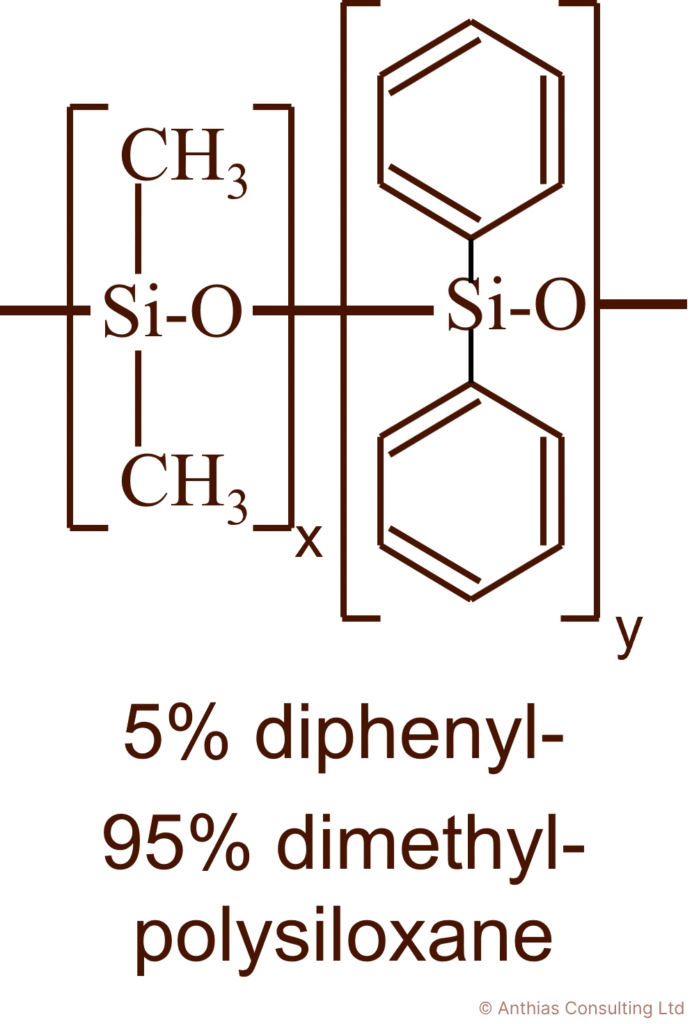
By far the most commonly used GC column is an X-5 with 5% diphenyl functional groups on a polydimethylsiloxane phase (Figure 1), usually with the dimensions of 30 m length, 0.25 mm internal diameter and a 0.25 um film thickness. This is a robust phase, has a high temperature limit of around 350°C, gives good resolution for many applications and survives most unknown samples being injected into it. So why do we need more polar, unstable phases with a lower temperature limit?
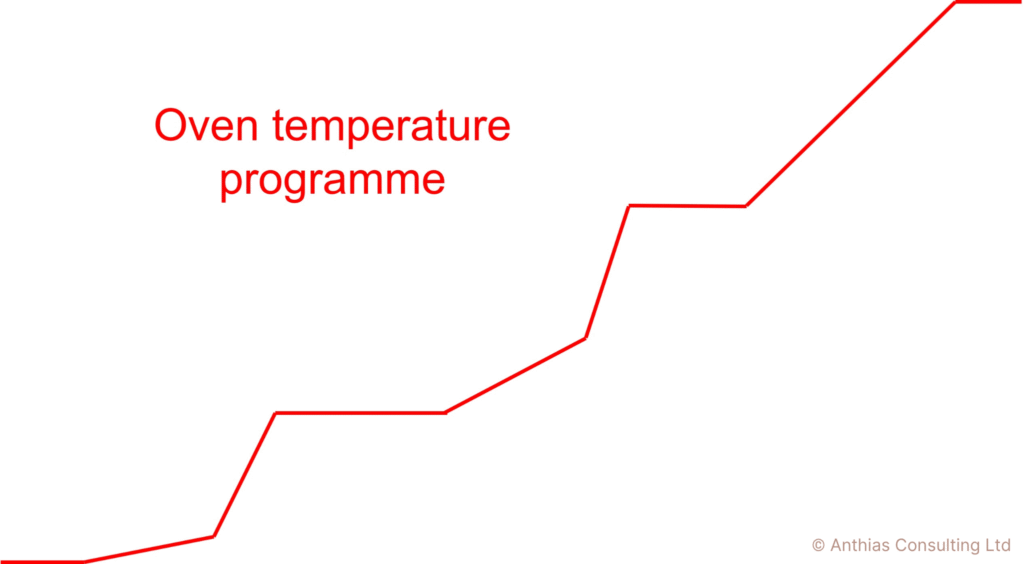
Over the years I’ve seen many methods with multiple oven temperature ramps, with ramp rates ranging from 40°C/min to 2°C/min in a single run, making the method quite complicated (Figure 2). In addition, the run time increases and, in some circumstances, slowing the ramp rate decreases the resolution due to longitudinal diffusion because the analytes have been in the column so long! Programming the column flow or head pressure are also common ways to try to improve the separation in a method although going beyond the optimal average linear velocity from the van Deemter curve (too slow or too fast) will also reduce resolution rather than improve it. Often these types of analyses involve the use of the ‘standard’ column, making the method more complicated and the run time longer than it really needs to be.
When developing a method, separation of the target analytes needs to be adequate for the questions to be answered, the matrix and the detector used. It may be the case that the ‘standard’ column achieves all of this with a simple method, however this may not be the case. The column phase is one of the most powerful parameters to achieve the best separation, so before making your method more complicated and spending lots of time trying to get the ramp rate from time A to time B just right using the ‘standard’ column, think about trying a better phase which could result in a more robust, faster method with analytes eluting at lower temperatures and with improved resolution and sensitivity. Which phase to choose depends on the physical and chemical properties of the analytes i.e. the volatility and the types of chemical interactions they can achieve, using a ‘like separates like’ approach.
To learn more about GC columns and how to choose them, attend:
- Practical Essentials of GC columns, detector and mass spectrometers, day two of our Complete GC & GC-MS course.
- Practical Essentials of GC columns, module four of our Complete GC & GC-MS course.
- Hands-on GC theory and methods, day one of our Hands-on GC and GC-MS course.
- Comprehensive GC hardware (Agilent GC)
- Comprehensive GC hardware (Shimadzu GC)
- Comprehensive GC hardware (Thermo GC)
- Comprehensive GC hardware (Scion/Bruker/Varian GC)
Don’t forget that you can also subscribe to our newsletters and receive useful tips straight to your inbox!


