
Published: 18th August 2026 | © Anthias Consulting Ltd
In GC-MS, library integrity has massively evolved compared to 30 years ago. In those times the NBS library had 72000 compounds, this was superseded by a Wiley library of 230000 compounds in the late 90’s that for the first time contained multiple synonyms greatly helping identifications. NIST libraries became mainstream around the year 2002 and are re-issued at least every three years, Wiley libraries are also much larger and are very much the library of choice in several industries.
In GC-MS we are spoiled in that the analytical conditions are fairly simple and everyone around the world generates their spectra using 70 eV electron ionisation thereby giving robust and therefore repeatable reference data. Softer ionisation is starting to be used, but there are limited libraries and most people create their own.
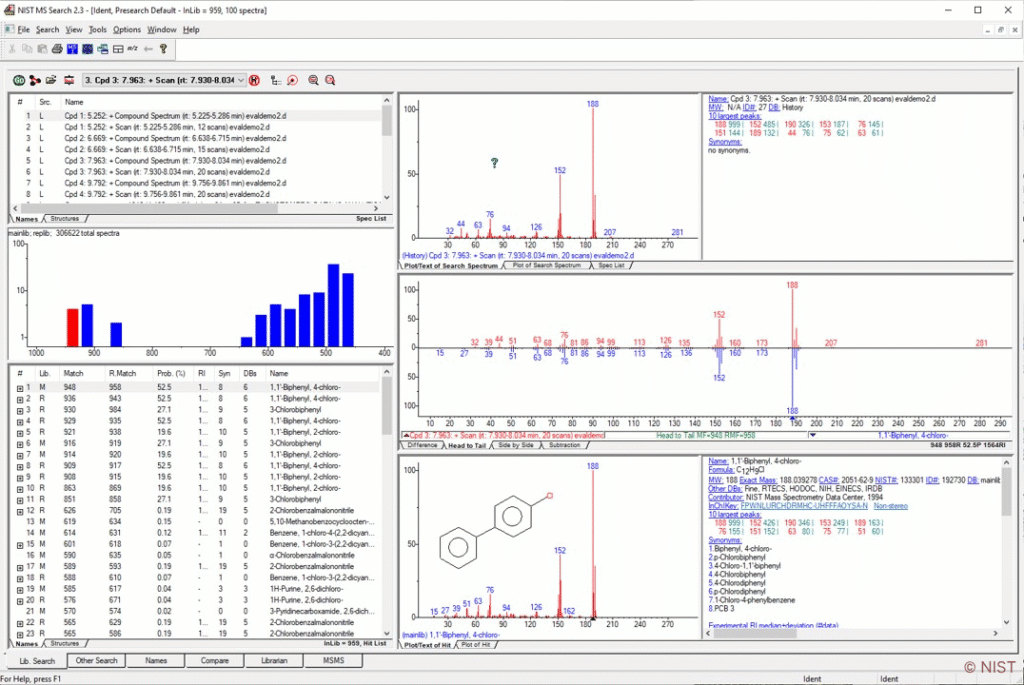
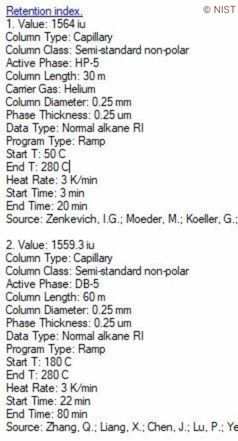
The search functions are powerful and varied (Figure 1), synonyms are plentiful and lots of Retention Index data (Figure 2) is now included and is starting to be used by more and more industries.
However, the correct identification relies on a number of key points, for instance:
- Is the correct spectrum being searched? Problems like peak coelutions, high baseline chemical noise that hasn’t been subtracted, the wrong position on the peak for a scanning instrument suffering from spectral tilting, etc. could result in a poor or incorrect match. Deconvolution can help here.
- Is the acquisition instrument correctly tuned and the method optimised to give the correct spectra for searching? In the libraries there are usually multiple spectra (replicates) from slightly different instruments – different manufacturers, different mass analysers, with or without a GC on the front end which usually have the same ions but slightly different relative ratios. However, if your instrument is out of tune or you have an unusual mass spectrometer or one that doesn’t produce classical mass spectra then you might not find a good match!
- Which isomer is it? Many isomers produce from similar to exactly the same spectra that can’t be differentiated, that’s where retention indices come in to identify them, as long as you have separated them on the analytical column.
- What chain length does it have? Hydrocarbons, etc. have similar mass spectra and a small molecular ion that disappears with increasing chain length. Again, the only way to differentiate them is to use the GC retention time.
- Is the unknown present in the library? Mass spectral libraries aren’t exhaustive and sometimes your compound just might not be present. Knowing the fundamentals of mass spectra interpretation is very important, even if it is just to confirm the library match is correct!
To learn more about library searching and retention indices attend
To learn more about deconvolution attend
- Absolute Basics of Deconvolution
- Comprehensive Deconvolution (NIST AMDIS)
- Comprehensive GC-MS (Agilent SQMS with MassHunter)
To learn more about mass spectral interpretation
- For GC-MS attend Applied Interpretation of GC-MS spectra
- For LC-MS attend Applied Interpretation of LC-MS spectra
- For FTIR attend Applied Interpretation of FTIR spectra
Don’t forget that you can also subscribe to our newsletters and receive useful tips straight to your inbox!


