
Applied Interpretation of LC-MS spectra

- Duration: 3 days for live courses 20 hours for on-demand
- Experience level: Advanced
- Delivery methods: Face-to-face | Offsite training & consultancy | On-Demand | Online | Onsite training & consultancy | Tailored training |
- Type of course: Universal
- Applicable to manufacturer(s): Agilent | Bruker | JASCO | PerkinElmer | Sciex | Scion | Shimadzu | SRI | Thermo | Varian | Waters |
- CPD Approved: Approved
- Scheduled course price: £1,375.00 + TAX per delegate
- Course discounts: RSC CAMS HEaTED Cambridge Network members receive a discount on this course
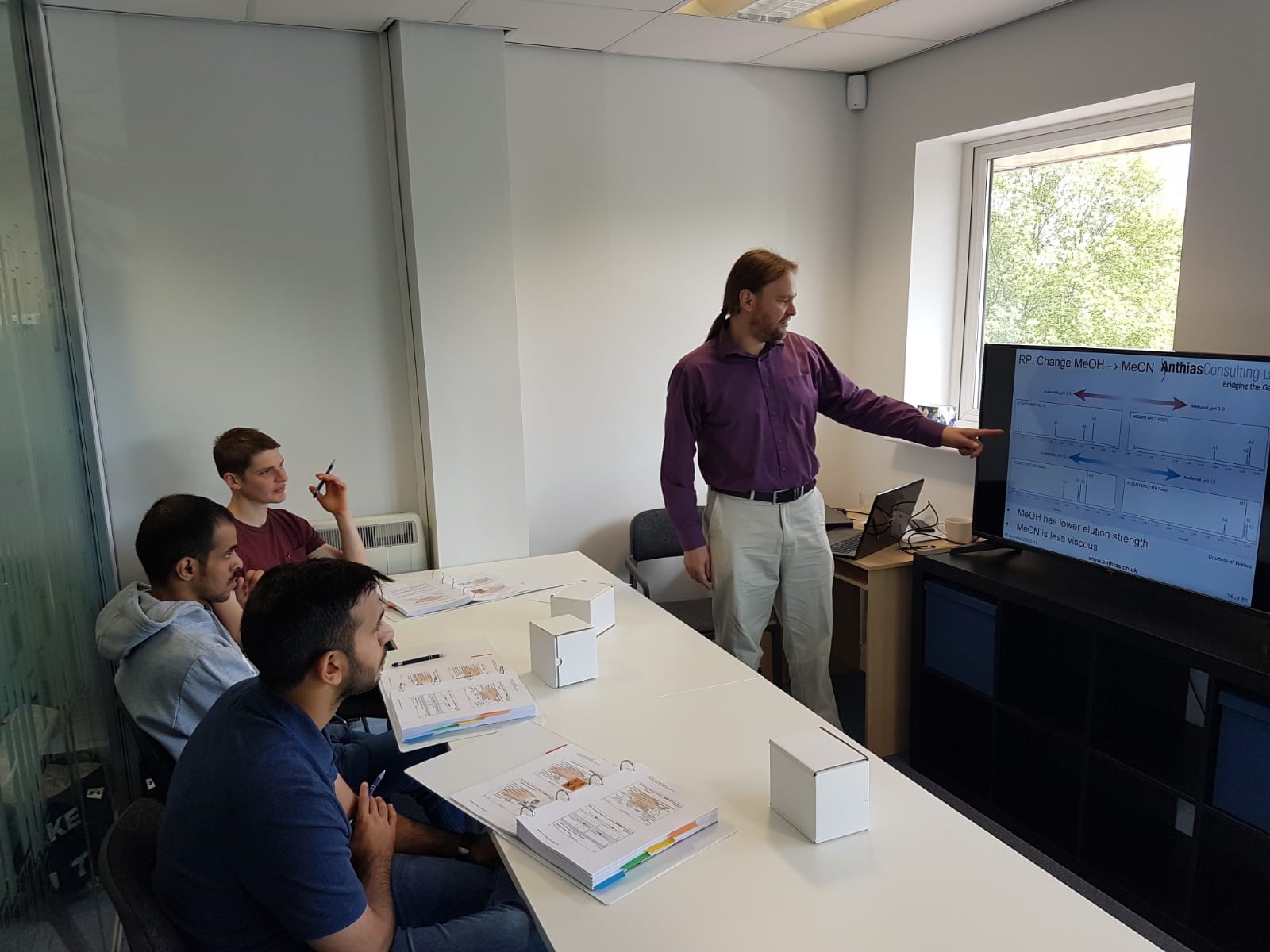
Your advanced guide to interpreting spectra produced by mass spectrometers hyphenated to liquid chromatographs (LC-MS)
Go beyond the basics of liquid chromatography-mass spectrometry (LC-MS) with this 3-day classroom-based, advanced course interpreting LC-MS spectra, that is approved by the Royal Society of Chemistry (RSC) for Continuing Professional Development (CPD). Designed for those professionals, students and chemists who already have a solid understanding of LC-MS but want to enhance their knowledge further. Go into the fundamental tools and rules used when examining high-quality full scan LC-MS data and get lots of practice with more than 40 exercises. Every LC-MS analyst should have a solid understanding of mass spectra and how to interpret them correctly.
This LC-MS spectral interpretation course aims to enhance mass spectral knowledge by teaching you to quickly recognise from the spectrum if an analyte is aliphatic or aromatic in nature, to learning to interpret the number of carbon atoms, heteroatoms and degrees of unsaturation. This interpretation course will further teach you to understand logical and illogical losses alongside cleavages and rearrangements that produce a mass spectral fingerprint of the compound being analysed.
This course combines the theoretical side of mass spectral interpretation with a high proportion of exercises to reinforce the topics learnt throughout this course.
Why should I join?
On completion of this training, you will have an in-depth understanding of interpreting LC-MS spectra. From looking at the fundamentals and tools required for interpreting complex spectra to how to generate a high-quality mass spectrum ready for interpretation.
This Applied Interpretation of LC-MS spectra course gives you:
- The fundamentals of mass spectral interpretation for LC-MS
- Clear explanations of LC-MS spectra and the information they provide
- Enhanced understanding of fragmentation patterns produced by LC-MS analysis
- Fragmentation types including Pi electron fragmentation and non-bonding electron fragmentation
- Lots of practice with over 40 exercises to greatly strengthen your learning
- Confidence to interpret complex LC-MS spectra of unknown compounds
- A good stepping stone, taking your intermediate LC-MS knowledge to a more advanced level
- A great opportunity for LC-MS analysts to enhance their knowledge
This is your chance to take your knowledge of LC-MS to an advanced level!
What would I learn?
This advanced course focuses on the fundamentals of mass spectral interpretation of LC-MS data including:
- The importance of obtaining high quality mass spectra
- The mechanism of ionisation techniques such as electron spray ionisation (ESI) and atmospheric pressure chemical ionisation (APCI) and the different spectra they produce
- Learn simple techniques to recognise and elucidate spectra
- How to observe fragmentation patterns for a range of organic compounds
- How to recognise and use isotope patterns
- Learn how to interpret the number of carbon atoms in a molecule undergoing LC-MS analysis
- How to use advanced tools such as the nitrogen rule, logical losses (radicals and neutrals) and how to calculate the amount of unsaturation’s in a proposed molecule (known as Double Bond Equivalent (DBE))
- Work through exercises throughout the 3-day course applying the knowledge learnt to various spectra produced by LC-MS instruments
What knowledge will I gain?
By the end of the course, you will:
- Understand what constitutes an LC-MS mass spectrum and the information it provides
- Have an insight into how to obtain and the importance of high-quality mass spectra
- Understand ESI, APCI and APPI principles, alongside how these techniques can produce odd and even electron ions
- Discover how increasing collision energies can impact LC-MS spectra
- Comprehend the differences between saturated, unsaturated and aromatic hydrocarbons, and interpret their spectra with confidence
- Understand common tools and the different approaches used in the interpretation of unknown LC-MS spectra
- Understand McLafferty rearrangement and why it is an important tool in interpretation within LC-MS spectra
- Gain confidence in applying the skills, tools and knowledge learnt to your own work outside of this course
Is this course for me?
This RSC approved LC-MS course is designed for anyone who has good knowledge of the analytical technique LC-MS and would like an enhanced understanding of the interpretation of the mass spectra produced by LC-MS instruments.
- Analysts who use LC-MS in everyday analysis, whether this is routine or research
- Students who are currently studying and using LC-MS in their projects
- Laboratory or line managers overseeing LC-MS instruments and data
- Data analysts and report writers who work with and interpret LC-MS data
- Engineers, sales, commercial or marketing teams who work with LC-MS instruments and would like to take their knowledge to a higher level
If LC-MS spectral interpretation links to your work in anyway, this course delivered by experts in the field will provide you with a solid and deeper understanding of mass spectral interpretation for LC-MS along with lots of practice using the knowledge gained.
What's next?
Feedback from previous attendees
“The instructor was brilliant, so knowledgeable and helpful! The course was well presented and laid out to follow along, and the online set up worked really well.”’ Learning & Technical Resources, 2025
“Very practical, hands-on course. You leave with a clear picture of the road ahead, a roadmap on how to tackle the issues and toolkits that help you along the way.” Delegate, 2025
“The individual rules and tools were explained clearly and usually had a helpful summary slide to refer to for the exercises. The course material was clear, and knowledge of the consultant was really good.” Delegate, 2025
“Really excellent training. There are no courses available that typically target structural elucidation in LCMS in specific so this was exactly what our team needed.” Bespoke training, October 2020.


