
Absolute Basics of HPLC and LC-MS
- Duration: 1 day for live courses 6.50 hours for on-demand
- Experience level: Beginners
- Delivery methods: Face-to-face | Offsite training & consultancy | On-Demand | Online | Onsite training & consultancy | Tailored training |
- Type of course: Universal
- Applicable to manufacturer(s): Agilent | Bruker | JASCO | PerkinElmer | Sciex | Scion | Shimadzu | Thermo | Varian | Waters |
- CPD Approved: Approved
- Scheduled course price: £385.00 + TAX per delegate
- Course discounts: RSC CAMS HEaTED Cambridge Network members receive a discount on this course
Your beginner’s guide to high-performance liquid chromatography (HPLC) and liquid chromatography mass spectrometry (LC-MS)
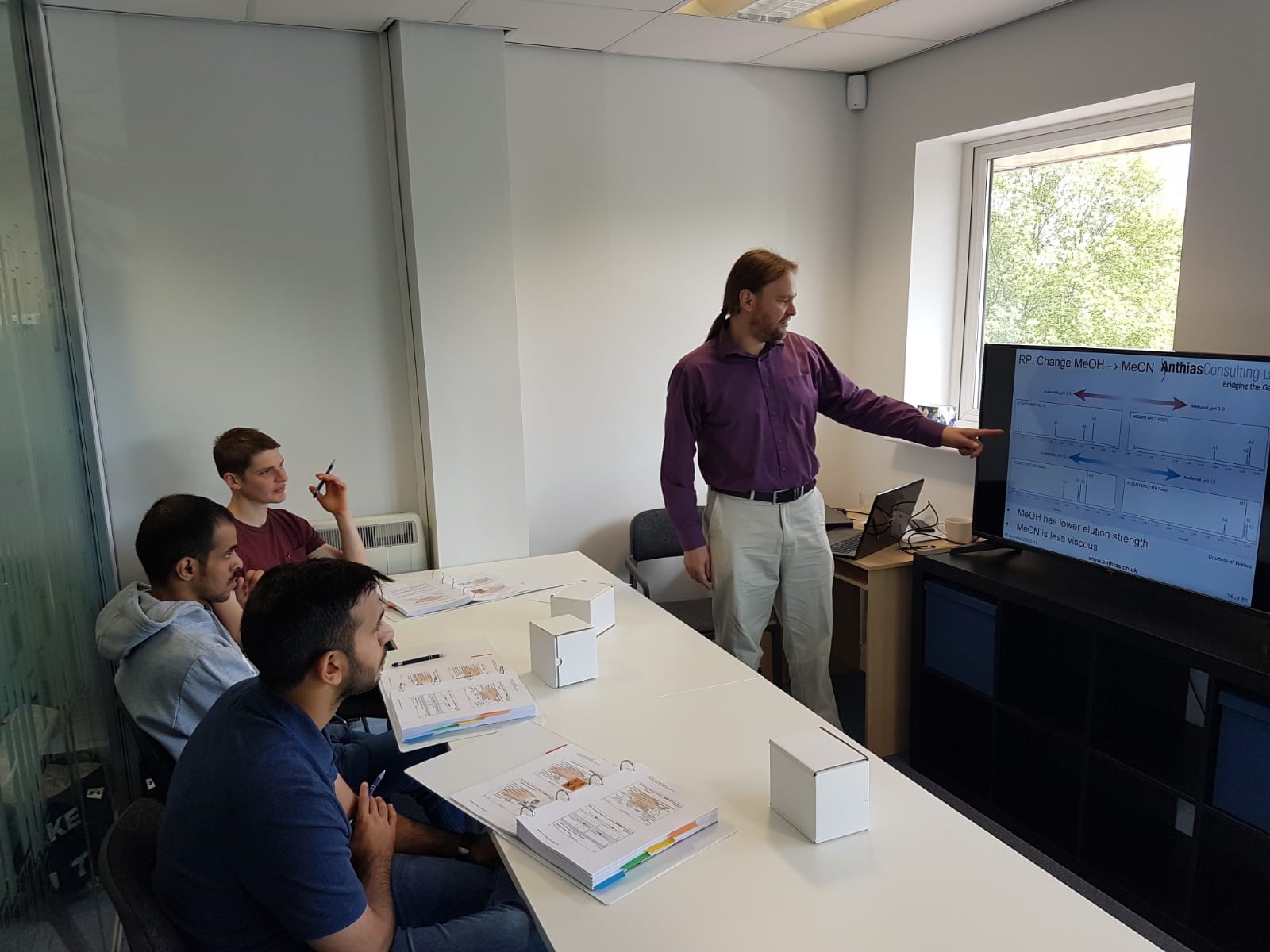
Learn the fundamentals of high-performance liquid chromatography (HPLC) and liquid chromatography mass spectrometry (LC-MS), with this 1-day classroom-based beginners course for professionals and students that is approved by the Royal Society of Chemistry (RSC) for Continuing Professional Development (CPD). This introductory, analytical chemistry course will cover the what, how, why, where and when of HPLC and LC-MS and will take you from sample introduction through to understanding chromatograms and mass spectra. Improve your understanding further with the opportunity to handle (see, in virtual courses) HPLC and LC-MS instrument parts and consumables such as an MS quadrupole, turbo pump, detector lamp and LC analytical columns.
Whether you’re stepping into the world of HPLC and LC-MS for the first time, or looking to refresh your technical expertise, this essential training course gives you the knowledge you need to understand analytical chromatography and, start using HPLC and LC-MS. These foremost analytical chemistry techniques are used to identify and quantify compounds in complex mixtures and are used in laboratories worldwide. This course breaks complex HPLC and LC-MS instrumentation and techniques into easy-to-understand concepts, helping you to build skills that you can use in the lab.
Why should I join?
On completion, you will be able to understand what defines HPLC and LC-MS techniques, their typical applications and the methods use of the mobile and stationary phases to separate chemicals in a sample mixture, through to the mass spectrometer’s ability to ionise molecules, produce fragment ions and measure these based on their mass-to-charge (m/z) ratio.
This liquid chromatography training course gives you:
- A solid understanding of the techniques used in HPLC and LC-MS
- Clear explanations of analytical chromatography and mass spectrometry
- Insights into HPLC and LC-MS components such as analytical columns and various detectors
- Understanding of basic data analysis from chromatogram interpretation to the use of a mass spectrum
- Familiarity with basic sample preparation techniques including solid phase extraction (SPE) and liquid-liquid extraction (LLE)
- Real-world exercises of applications across many different industries
- A great summary of both HPLC and LC-MS aided with an acronym glossary
This is your opportunity to understand two of the most widely used analytical techniques, HPLC and LC-MS in modern science.
What would I learn?
A beginner‑friendly introductory course, focusing on the what, how, why, where and when of HPLC and LC‑MS, including:
- What HPLC and LC-MS are
- The processes of chromatographic separation and mass spectrometry
- What chromatography is and the different types
- What defines both HPLC and LC-MS and the common terminology used
- What a chromatogram and a mass spectrum are and the information they provide
- How HPLC and LC-MS work
- The core principles behind HPLC and LC-MS
- How the stationary phase and mobile phase work to perform the chromatographic separation
- How reversed phase HPLC and normal phase HPLC are used
- How different universal and selective detectors work such as a UV-Vis or fluorescence detectors
- How different ionisation techniques work, including electrospray ionisation (ESI) and atmospheric pressure chemical ionisation (APCI)
- How mass spectrometers work including the vacuum, ion source, quadrupole and time-of-flight (TOF) mass analysers, MS/MS and the electron multiplier (EM) ion detector
- How mass spectrometers produce 3D data and can be used for spectral separation
- Why we use HPLC and LC-MS
- The use of HPLC for qualitative analysis and quantitation, data analysis
- Why LC-MS can additionally be used for the identification of unknown compounds
- Why internal standards are useful in HPLC and LC-MS analysis
- Where HPLC and LC-MS is involved
- The analysis of liquid and solid samples
- Where different sampling techniques used for HPLC and LC-MS including SPE and LLE, alongside filtration methods
- When HPLC and LC-MS is the right choice
- Real-world, interactive, exercises of example applications across clinical analysis, the environmental industry, pesticide screening, forensic work, food analysis and diet and health
- When we would use a suitable sampling technique, analytical column and detector for various matrices
What knowledge will I gain?
By the end of the course, you will:
- Understand the principles and concepts of HPLC and LC-MS
- Know the key instrument components and workflows from sample introduction to data collection
- Feel confident discussing HPLC and LC-MS instrumentation and results
- Understand the various types of HPLC and LC-MS instruments available, mobile and stationary phase differences and types of detectors
- Be familiar with common sample preparation techniques in HPLC and LC-MS
- Comprehend the principles behind chromatograms, mass spectra and data analysis
- Recognise how HPLC and LC-MS are used across diverse industries
This course gives you the language and understanding needed to work with HPLC and LC-MS systems, even if you aren’t the person pressing the buttons.
Is this course for me?
This training is designed for anyone who needs a solid grounding in HPLC and LC-MS, including:
- For beginners to HPLC and/or LC-MS
- Analysts & technicians wanting a clear, structured refresher
- Laboratory or line managers overseeing HPLC and LC-MS instruments
- Data analysts and report writers who interpret results but do not use the instruments
- Service and consultant engineers who need a chemistry-focused viewpoint
- Sales, marketing, or commercial teams working with HPLC and LC-MS systems, consumables, data or laboratory services
If HPLC or LC-MS touches your work in any way, this well-planned RSC CPD approved course delivered by experts in the field equips you to understand the science behind these techniques.
What's next?
Feedback from previous attendees
“A really detailed basics course that covered a lot more of the theoretical side of HPLC & LC-MS. I found it very easy to follow along & it was a perfect refresher course for me. It helped me bridge some of the knowledge gap I had, especially about MS.” Delegate, 2026
“Other courses provide a very brief knowledge around different industries, but Anthias has covered almost all examples & the instructor gave an understanding of the variety of samples used in the industry”’ Laboratory Technician, 2026
“Material well structured, presenter went into detailed answers on all the questions & gave loads & loads of examples. We got to see parts of the instruments which was very useful.” Product Development Intern, 2026
“Diane was extremely knowledgeable and shared her knowledge in an easy to understand way.” Delegate, April 2023.
“Although I did not watch the video live, I enjoyed the last part of the course where we should interact in the classroom and suggested answers for the analysis of some analytes.” On-Demand Virtual Classroom: Absolute Basics of HPLC & LC-MS, 2021.
“I’ve enjoyed that the machinery and some parts of the instruments were shown and described (photos and real-life on the tutor desk). I’ve liked taking part in solving the problems with the instructor at the end of the course and talking about real-life examples, where HPLC can be used and what can be tested with it. The slides were very neat and clearly presented with a good amount of images and graphs added.” Live Virtual Classroom: Absolute Basics of HPLC & LC-MS, May 2020.
“I really enjoyed the interactive questions at the end to test our knowledge. I enjoyed learning about quadrupoles the most.” Delegate, April 2023.
“(I enjoyed) the interactiveness of the course, all of the instrument parts that got passed around.” Onsite training, June 2022.
“Engaging course instructor, being able to see and pass around the parts, interesting and good pace.” Onsite training, June 2022.
“Getting hands on with instrument parts – really gives context and further info.” Onsite training, June 2022.
“The breakdown of different sections of the LC and MS rather than viewing them as a whole.” Onsite training, June 2022.
“It was a very good refresher for me personally.” John Adey, Scientist, Environment Agency (February 2018).


